Phase 1: Before — Prevention, preparedness and risk reduction
Guide for individuals, families and communities
Volcanic eruptions are natural phenomena that cannot be prevented. However, their consequences can be considerably reduced through knowledge of the existing hazards, scientific monitoring, land-use planning, the preparedness of individuals, families and communities, early warning systems, and an organized public response.
A volcano can generate hazards that greatly differ from one another. Depending on its characteristics and the type of eruption, it can produce ashfall, ballistic projectiles, pyroclastic flows, lava flows, volcanic gas emissions, lahars or mud and debris flows, landslides, fires, contamination of water sources, disruption of essential services, and other associated phenomena.
For this reason, there is no single protective measure valid for every eruption, nor for every territory.
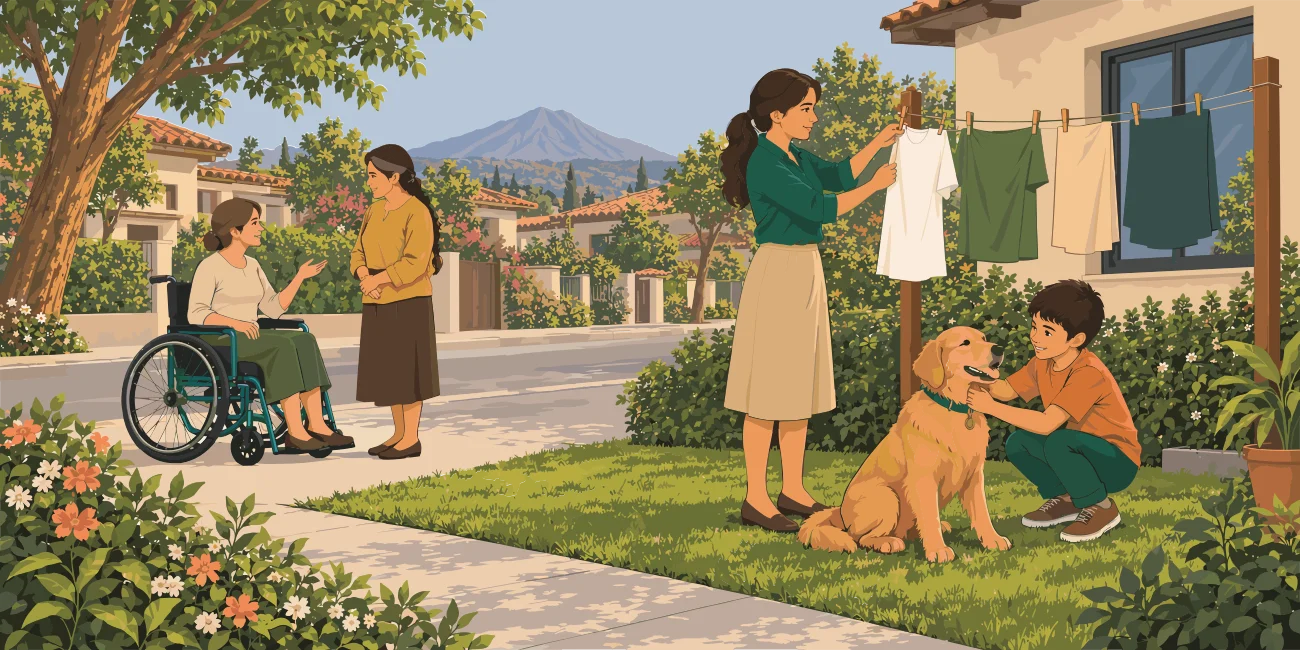
People, families and communities located in volcanic regions, or in areas that could be affected by ash or other volcanic products, must previously know the specific hazards in their territory and prepare their response procedures according to the maps, plans and provisions established by the relevant authorities.
1.1Know the volcanic risk of the area
Every person, family or community located in a potentially exposed region must begin by determining whether their home or community spaces are within a volcanic hazard zone.
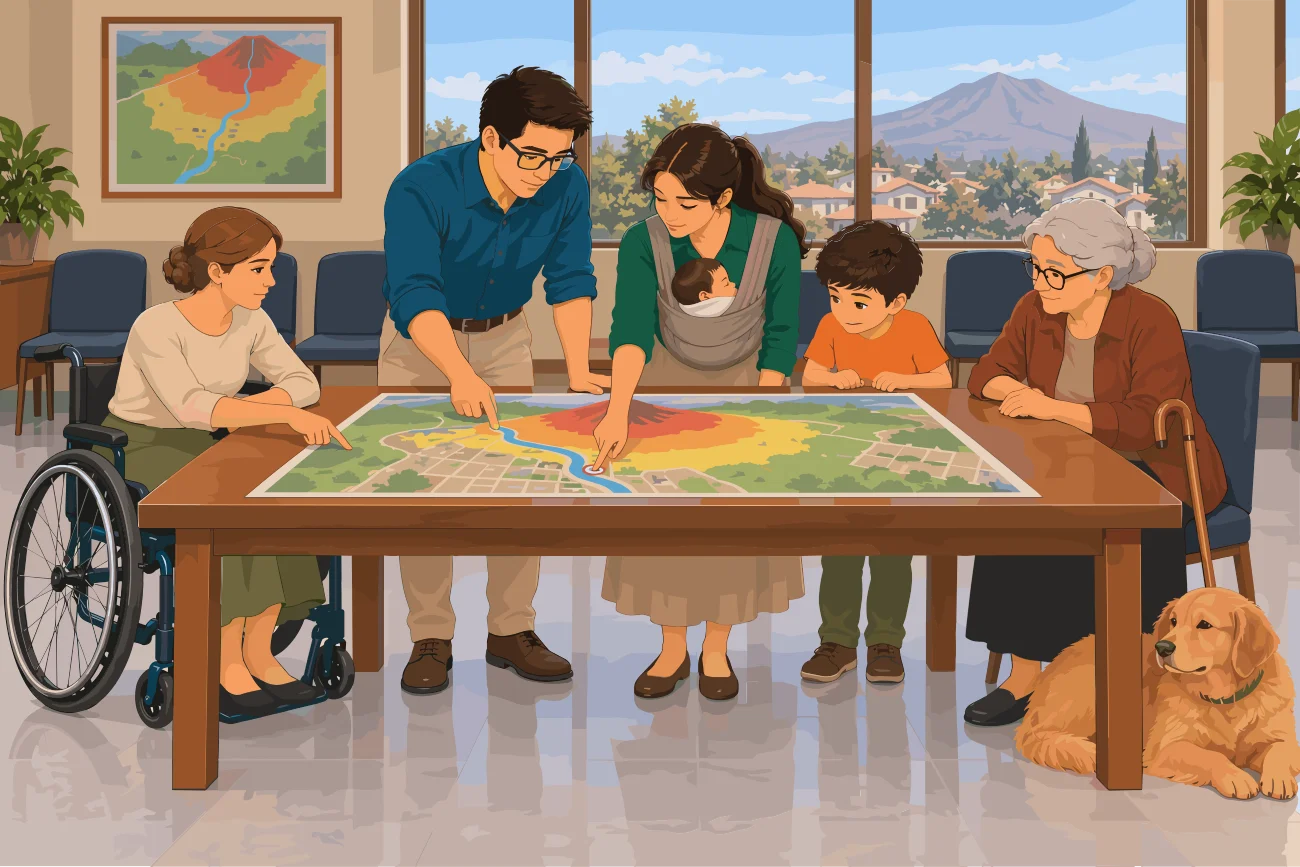
Every person, family or community should:
- Identify the active or potentially dangerous volcanoes in the region;
- consult the official volcanic threat or hazard maps available;
- determine which phenomena could directly affect the home or community spaces;
- identify the zones officially established for evacuation;
- know the evacuation routes determined by the authorities;
- identify shelters, refuges, meeting points and safe zones;
- know the agencies responsible for volcanic monitoring and emergency management;
- keep their phone numbers, websites, alert systems and other official communication channels up to date.
Particular attention should be paid to the location of the home or community in relation to rivers, ravines, gullies, valleys and other natural channels, because lahars can travel quickly along these corridors and reach places far from the volcano.
1.2Know the main volcanic hazards
Proper preparedness requires understanding that an eruption can produce different hazards.
1 · Volcanic ashfall
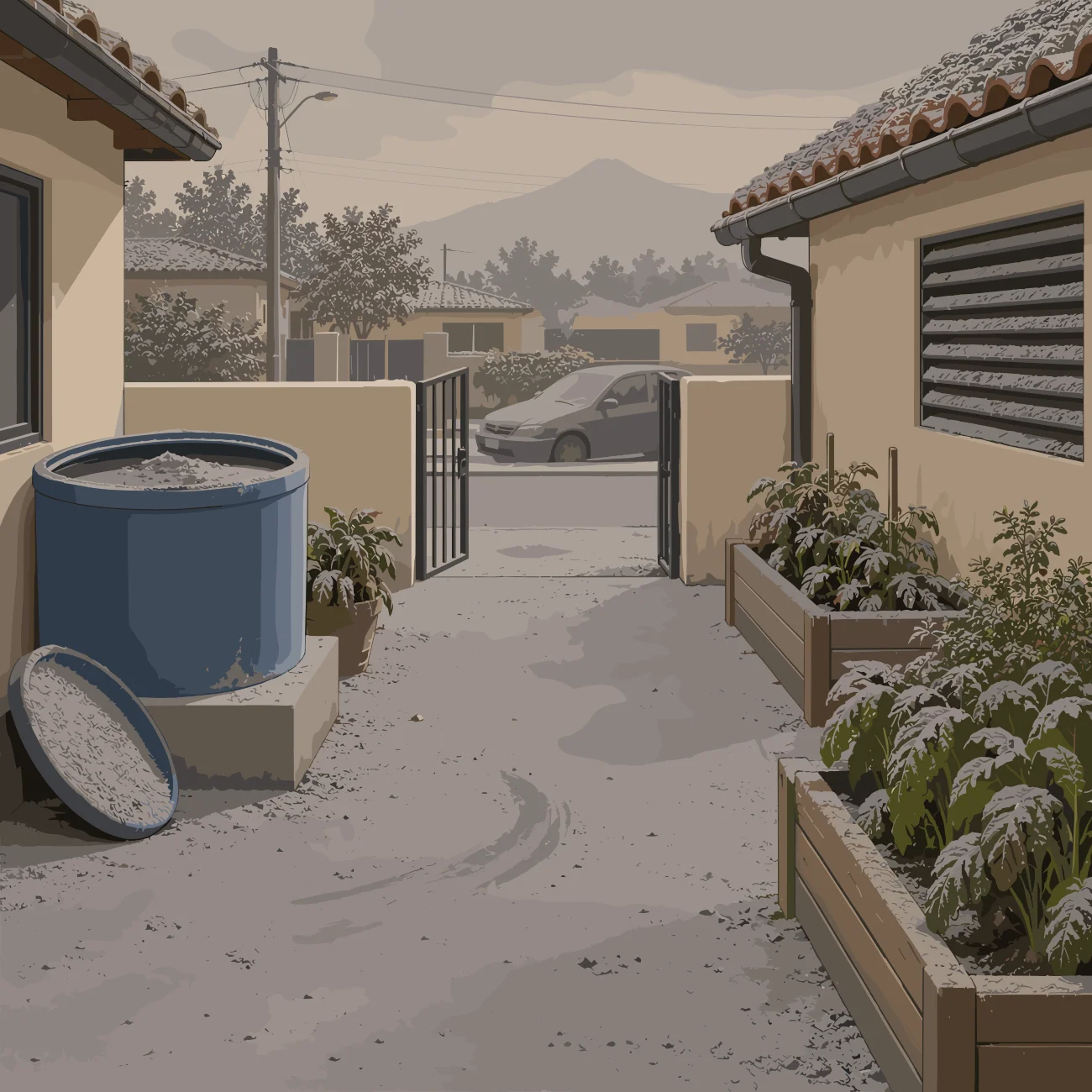
Volcanic ash is made up of very small fragments of rock, minerals and volcanic glass.
It must not be confused with the ash produced by burning wood or other materials.
It can:
- Irritate the eyes, nose, throat and airways;
- worsen pre-existing respiratory conditions;
- considerably reduce visibility;
- contaminate or affect water storage and supply systems;
- affect electronic and mechanical equipment;
- clog filters and ventilation systems;
- damage vehicles and machinery;
- affect crops and animals;
- make certain surfaces slippery;
- build up on roofs and structures.
2 · Pyroclastic flows
These are extremely hot mixtures of gases, ash and volcanic fragments that can move at very high speed.
They represent an extreme threat to life.
3 · Lahars
Lahars are flows of water mixed with ash, rocks and other volcanic material.
They can travel along:

river channels,
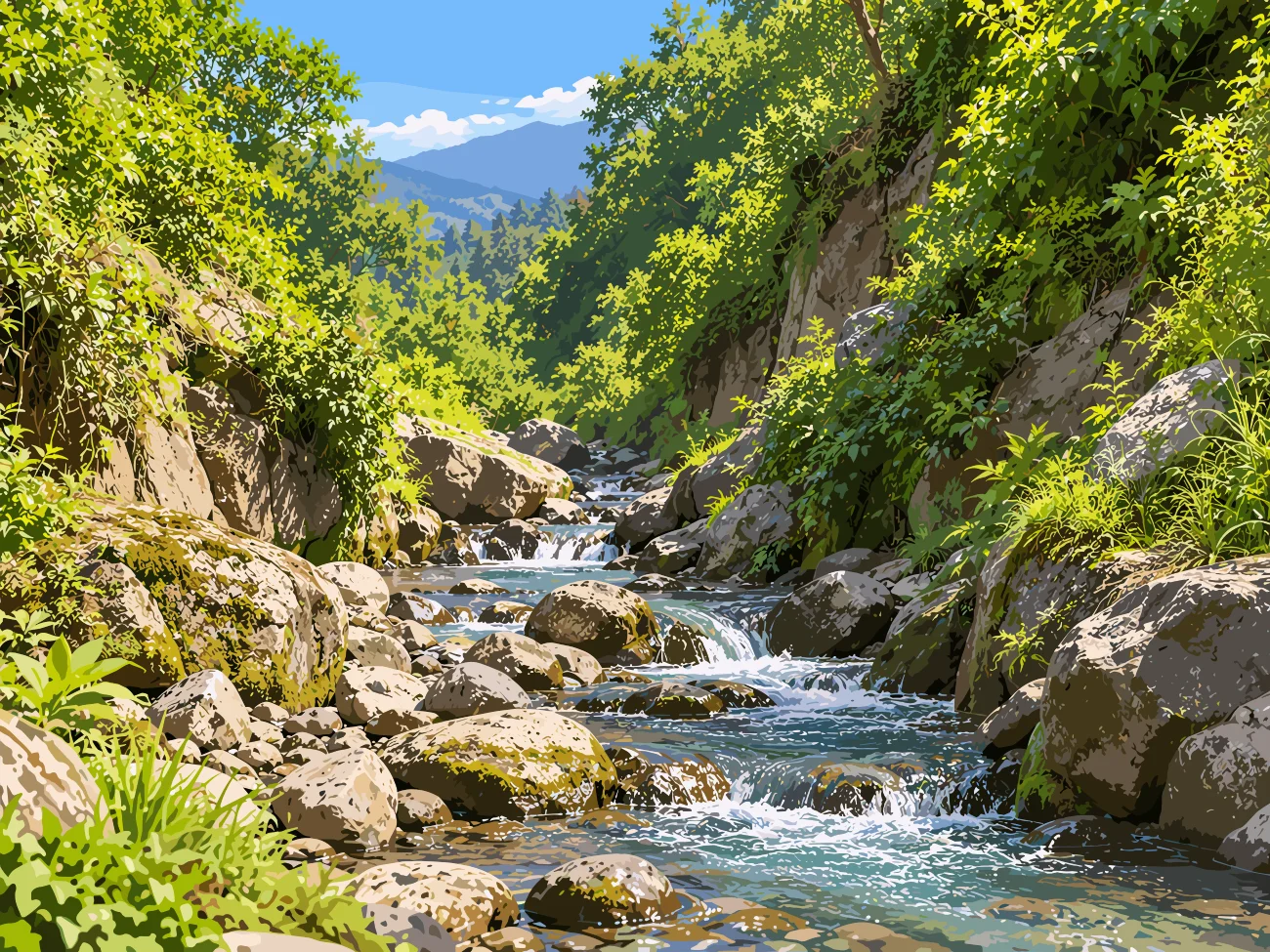
gullies,

ravines,
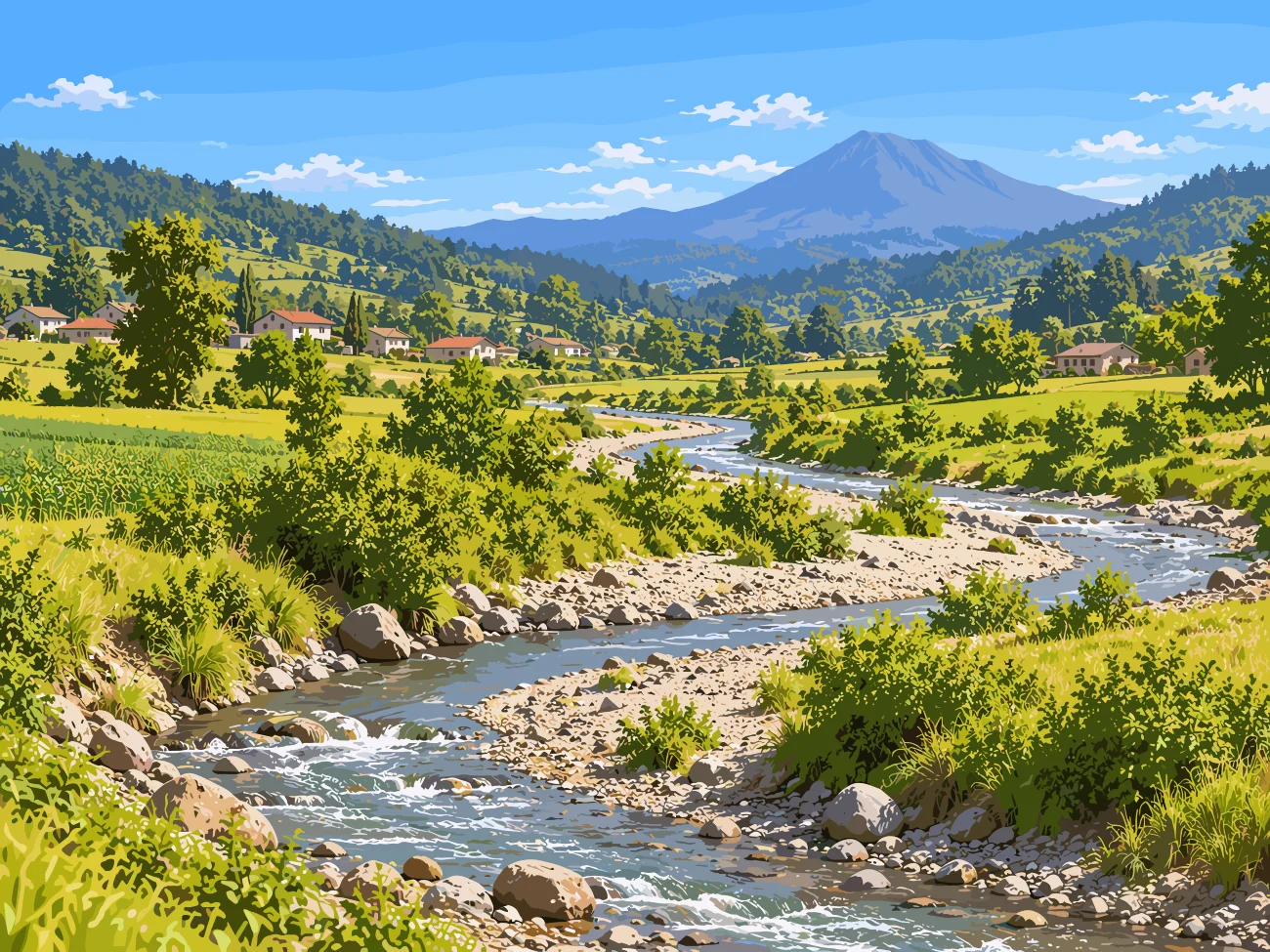
valleys,
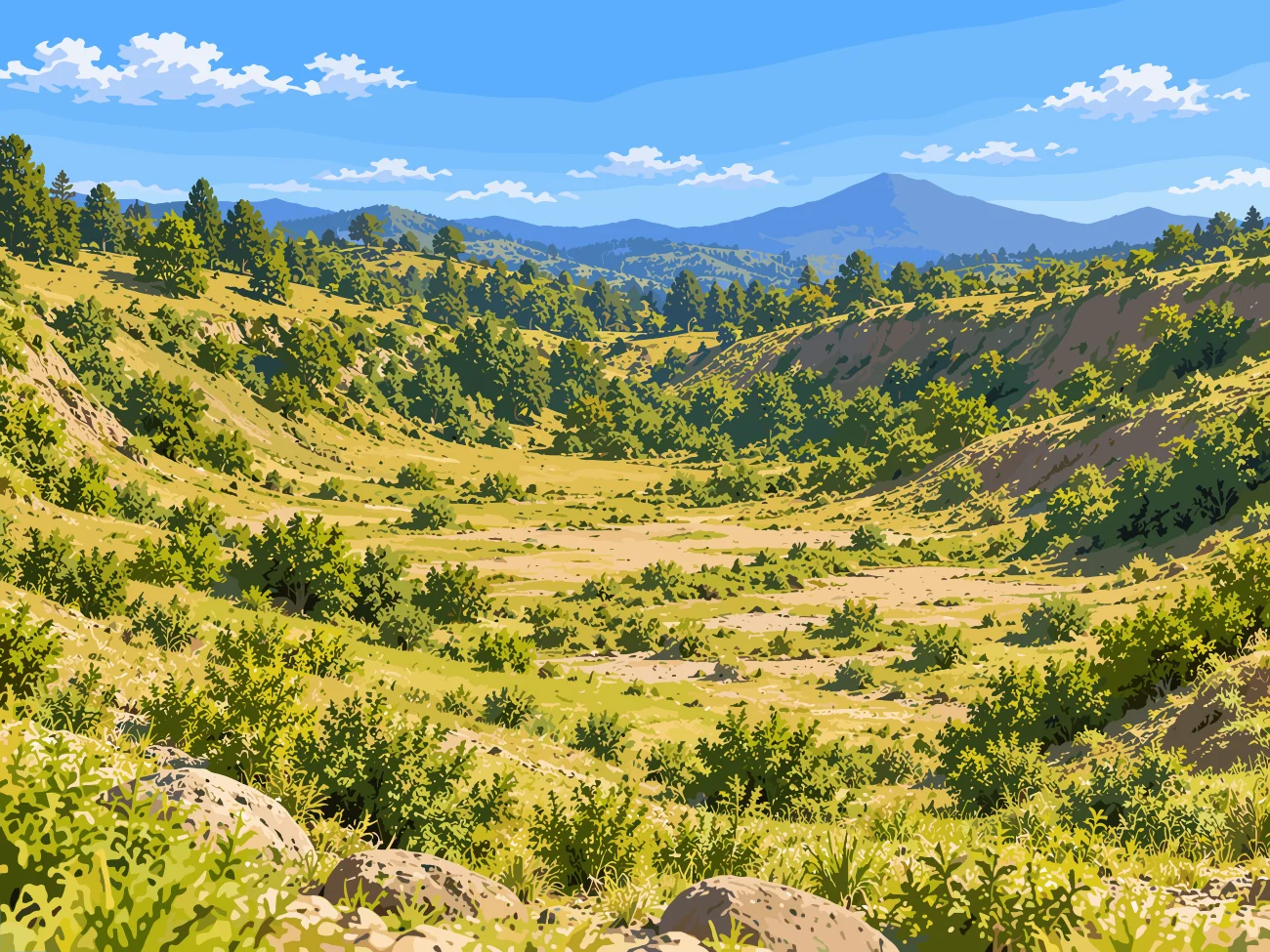
depressions in the terrain.
They can occur during an eruption or afterward, and under certain circumstances, even when the volcano is no longer in an intense eruptive phase.
For this reason, evacuation routes and safe zones must be established beforehand using the official hazard maps.
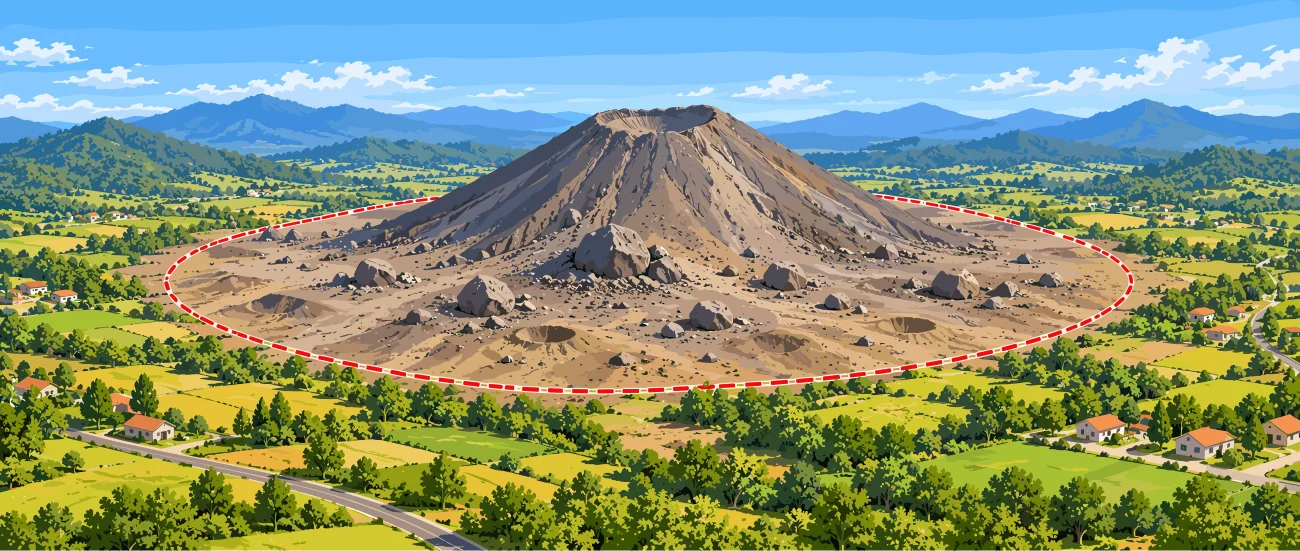
4 · Ballistic projectiles
During certain eruptions, blocks and rock fragments of considerable size can be ejected.
5 · Lava flows
Lava can destroy or set fire to buildings, roads, installations, vegetation and other infrastructure in its path.
6 · Volcanic gases
Volcanoes can emit sulfur dioxide, carbon dioxide and other potentially dangerous gases.
Some gases can build up particularly in certain depressions or low-lying areas, and dangerous concentrations cannot always be detected by smell.
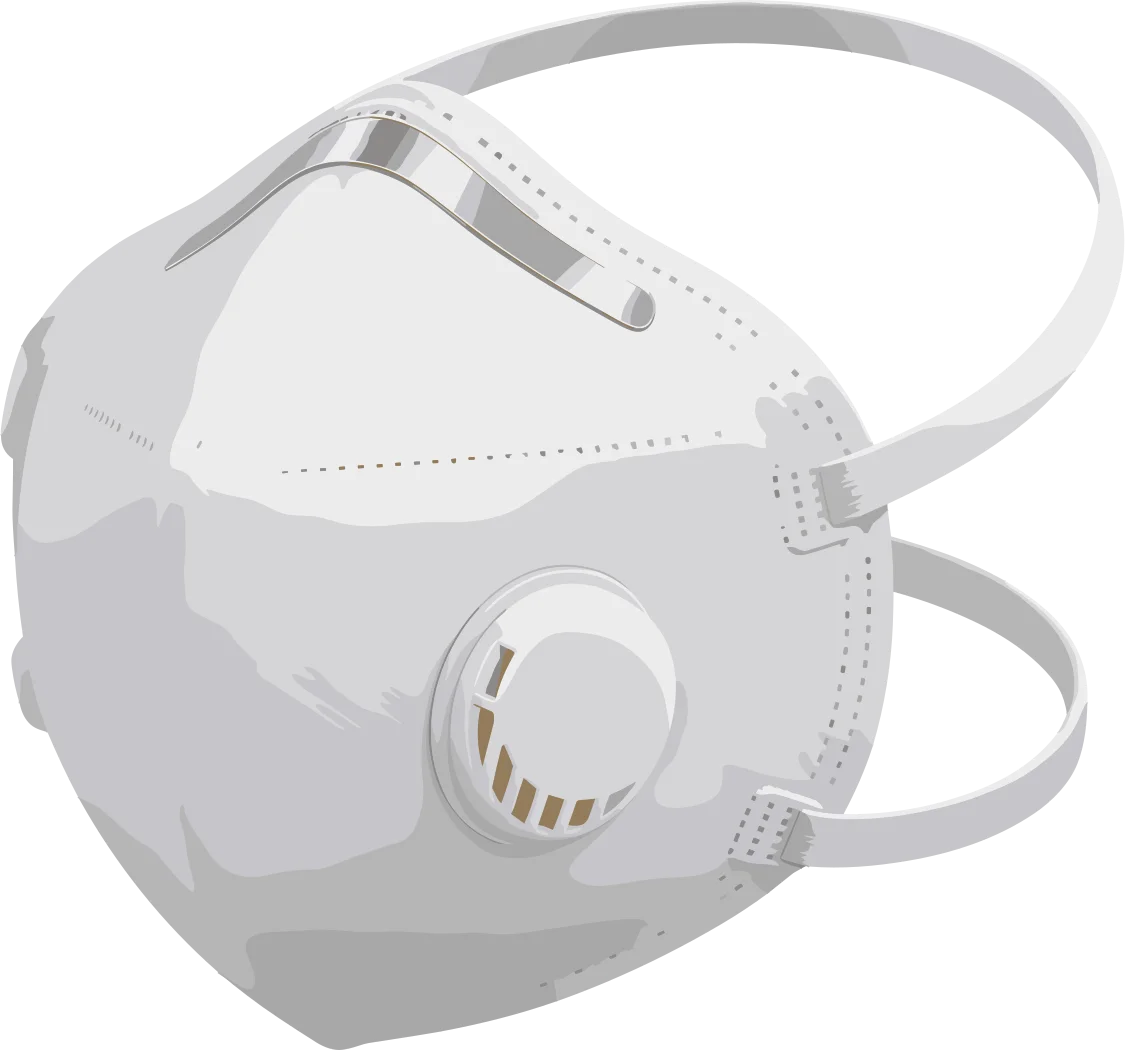
Keep in mind that particulate respirators, such as N95, P2 or FFP2, protect against ash particles when used correctly, but do not protect against toxic volcanic gases.
1.3Know the official alert system
Each person, family or community must know the alert system used specifically by the authorities of the country or region where they are located. Countries and monitoring agencies may use different scales, colors, numbers, names and alert levels.
For this reason, each person, family or community should know:
- Which agency sets the alert level;
- what each level means;
- what measures apply to each situation;
- how changes are communicated;
- who can order an evacuation;
- what the official channels of information are.
The meaning of a color used in one territory must not be carried over automatically to the system used in another.
The decisions of individuals, families and communities must always be based on the information and instructions issued by the relevant authorities.
1.4Assign emergency responsibilities
Every household and every community must have an internal organization established in advance.
It is recommended to assign:
- An overall emergency lead;
- one or more alternates;
- first aid leads;
- communications leads;
- leads for assisting people with disabilities or reduced mobility;
- leads for animals, where applicable;
- leads for documentation and essential items.
Roles must be established before the emergency.
1.5Develop an evacuation plan
Each family and each community must have a written plan that all its members know.
The plan should include:
- Main evacuation routes;
- alternative routes;
- meeting points;
- available means of transportation;
- procedures for people without a vehicle;
- mechanisms for evacuating people with disabilities;
- procedures for children, older adults and other people who need assistance;
- a system to check that the home or community spaces have been evacuated;
- a head count or registration procedure for people at the meeting point;
- specific procedures for animals;
- alternative destinations if the originally planned shelter is not available.
Routes must match those indicated by the authorities and take into account the hazards identified on the official maps.
1.6Do not establish universal evacuation times
There is no universal time —for example, 10, 15 or 20 minutes— that guarantees a safe evacuation in the face of a volcanic threat.
The time available will depend, among other factors, on:
- The location of the home or community;
- the volcano;
- the expected phenomenon;
- the distance from the threatened areas;
- the routes available;
- the authorities’ instructions;
- weather conditions;
- the number and characteristics of the people who must evacuate.
1.7Also prepare an indoor shelter-in-place plan
Not every volcanic emergency requires immediate evacuation. In certain ashfall situations, the authorities may recommend staying temporarily inside a building. For that reason, in addition to the evacuation plan, each family and each community must have a temporary shelter-in-place plan.
In advance, identify an area inside the home that:
- Can be properly closed off;
- has few openings to the outside;
- makes it possible to limit the entry of ash;
- can temporarily house the people present;
- is located away from systems that draw in outside air, when possible;
- allows reasonable temperature and ventilation conditions to be maintained in accordance with the authorities’ instructions.
Plastic sheeting, tape or other suitable materials should be available to reduce the entry of ash through major openings when necessary.
1.8Prepare emergency supplies
Every household and every community must maintain supplies suited to its size and location.
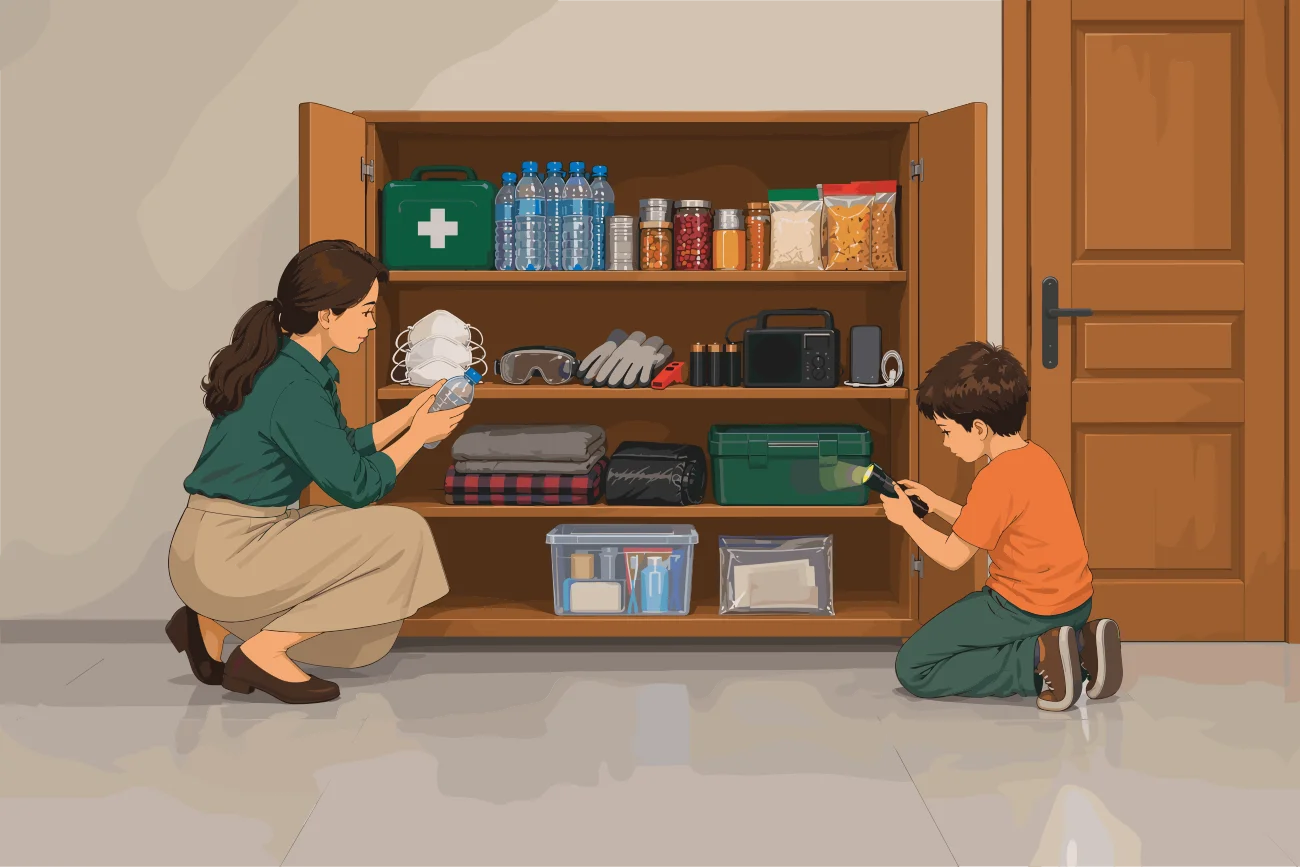
As a minimum, check whether the following are available:
- First aid kits;
- drinking water protected from contamination;
- emergency food, when applicable;
- spare batteries;
- battery-powered or hand-crank portable radio;
- charged power banks;
- basic hygiene items;
- flashlights;
- charging cables and devices;
- whistles;
- work gloves;
- protective goggles;
- suitable particulate respirators;
- authorized medications or medical supplies;
- sturdy bags;
- blankets;
- appropriate tools;
- protected copies of essential personal and family documents;
- lists of emergency phone numbers;
- a list of family and community leads;
- printed evacuation maps.
Supplies must be stored in accessible, protected places.
A regular system should be set up to check:
- expiration dates,
- condition,
- batteries,
- quantity available,
- whether equipment works.
1.9Respiratory protection against ash
Every household and every community must have, when the risk of ashfall justifies it, certified particulate respirators.
For adults, properly fitted respirators (equivalent to N95, P2 or FFP2) offer considerably better protection against volcanic particles than handkerchiefs, cloths, or conventional masks.
Their effectiveness depends both on the filter's quality and on a proper fit to the face.
Remember:
- The respirator must cover the nose and mouth properly;
- people must know beforehand how to put it on;
- facial hair can prevent a proper seal;
- particulate respirators do not protect against volcanic gases;
- some people with respiratory or cardiovascular conditions may have difficulty using certain respirators and should follow the instructions of health professionals.
Respirators designed for adults may not fit children's faces correctly.
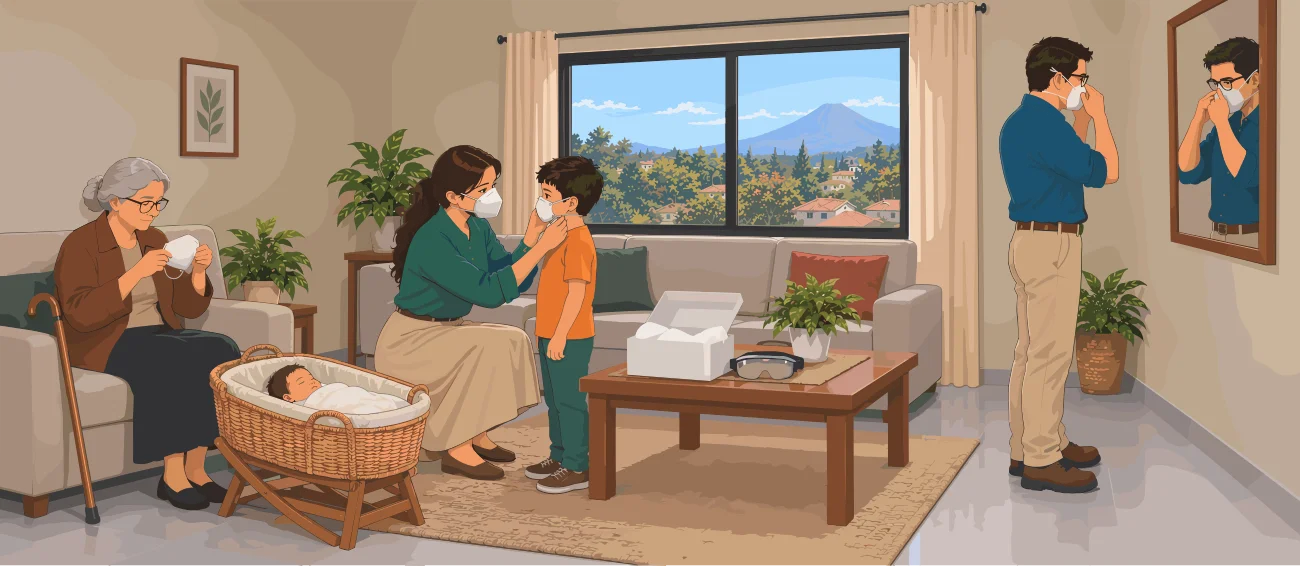
The main measure for reducing the exposure of people who are especially vulnerable to ash is to minimize that exposure as much as possible and, when appropriate, keep them indoors with the cleanest air possible.
1.10Eye protection
Ash can cause eye irritation and injuries. Each family and each community must have suitable protective goggles.
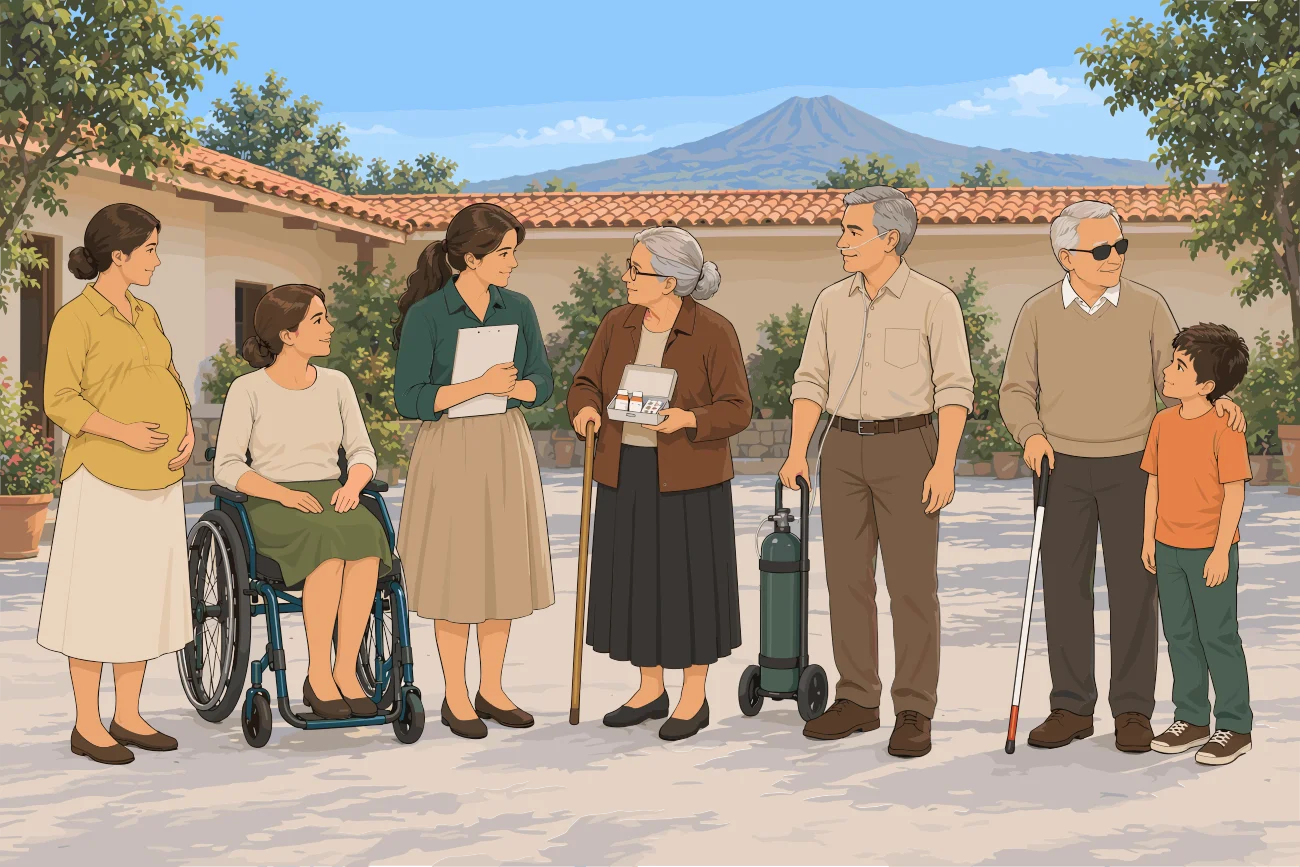
1.11Identify people who may need additional assistance
Before an emergency happens, a procedure must be established to assist, according to the characteristics of the family or community:
- People with disabilities;
- people with reduced mobility;
- older adults;
- children;
- pregnant women;
- people with respiratory conditions;
- people with cardiovascular conditions;
- people who depend on medications or medical devices;
- visitors or other people who are unfamiliar with the home or the area;
- anyone who needs assistance to evacuate or to protect themselves.
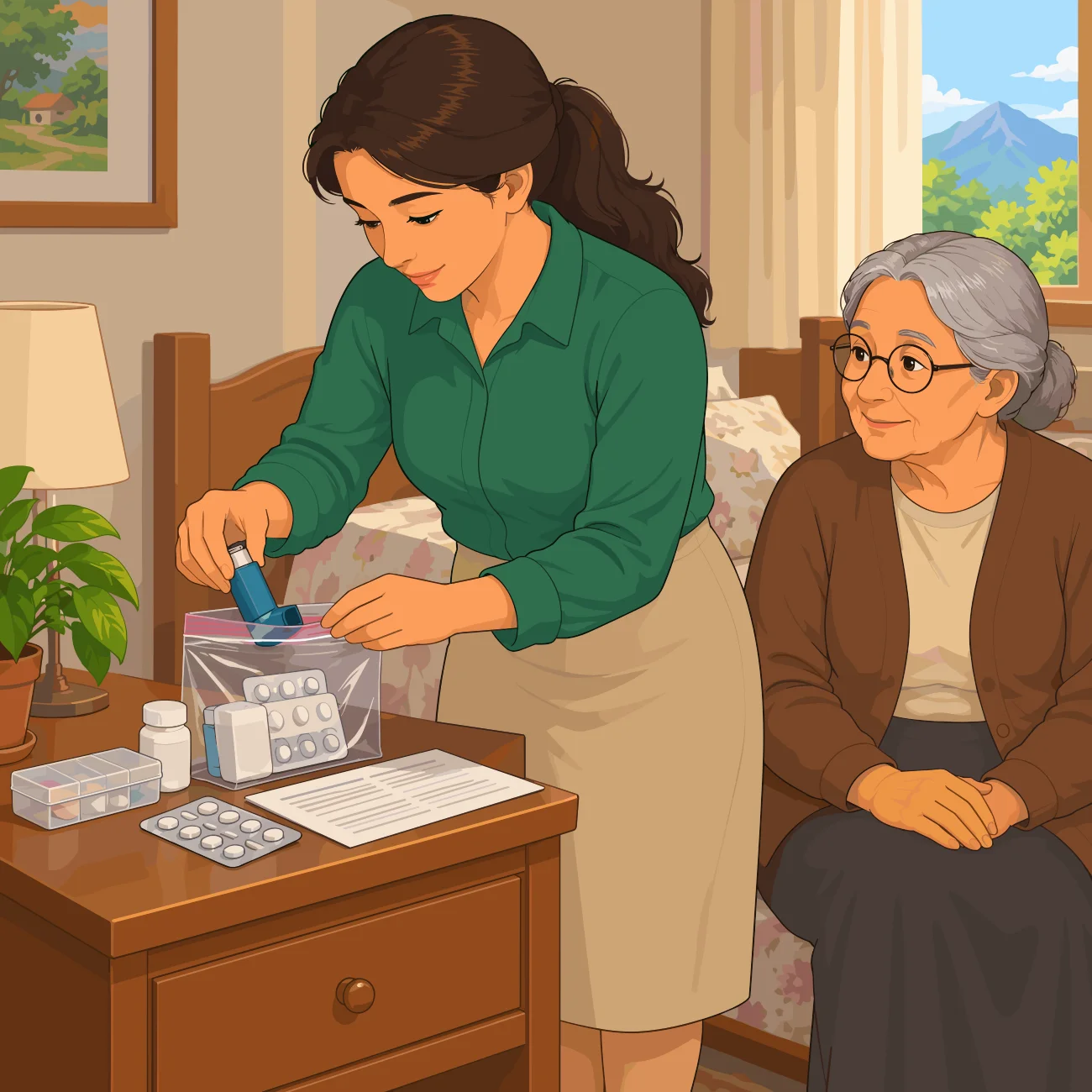
People who use essential medication should try to have a sufficient reserve to deal with temporary interruptions to their usual access to medication, following their health professionals' guidance and applicable regulations.
1.12People with asthma and other respiratory conditions
Ash and certain volcanic gases can worsen respiratory illnesses.
People with asthma, chronic obstructive pulmonary disease, or other respiratory conditions should have the following beforehand:
- Their regular medication;
- rescue medication, when prescribed;
- medical instructions for emergency situations;
- the devices recommended by their health professional;
- a procedure for leaving an affected area early when the authorities or health conditions recommend it.
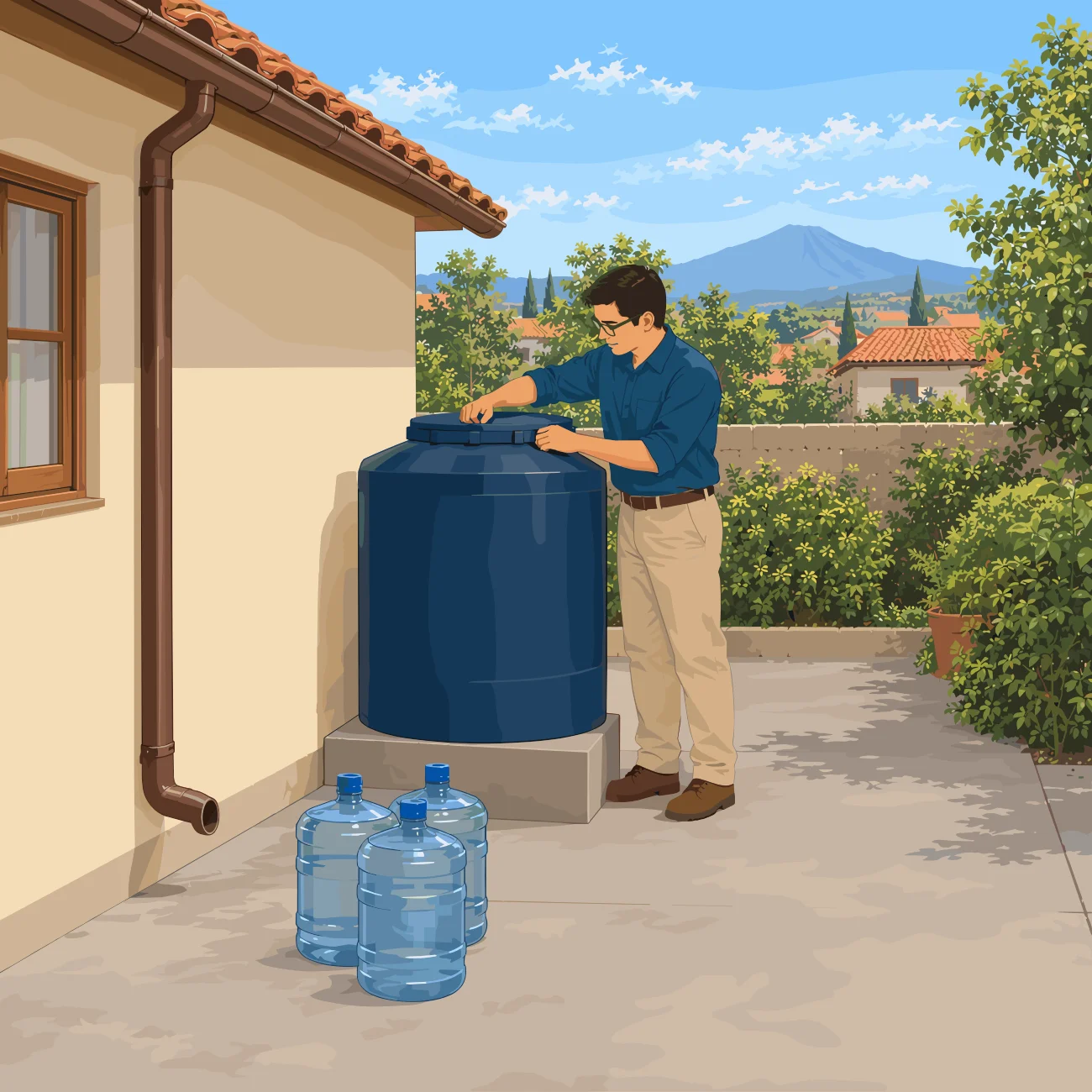
1.13Protect the water supply
Ash can get into cisterns, tanks, storage containers, water catchment systems and other installations.
Before an emergency occurs, you must verify that:
- Storage containers have appropriate lids;
- cisterns are protected;
- the vulnerable entry points are known;
- there is a reasonable reserve of drinking water;
- the procedure for isolating catchment systems is known, when applicable.
Families and communities that use rainwater must pay special attention to measures to prevent ash coming from roofs from entering the storage containers.
1.14Check roofs and structures
Ash accumulation can considerably increase the load on roofs, especially once it becomes wet.
Before an emergency happens, families and communities located in areas of potentially significant ashfall should have a technically competent person assess:
- The general condition of the roof;
- structural capacity;
- gutters and drains;
- lightweight roofing;
- deteriorated structures;
- areas where ash may accumulate;
- safe procedures for possible removal.
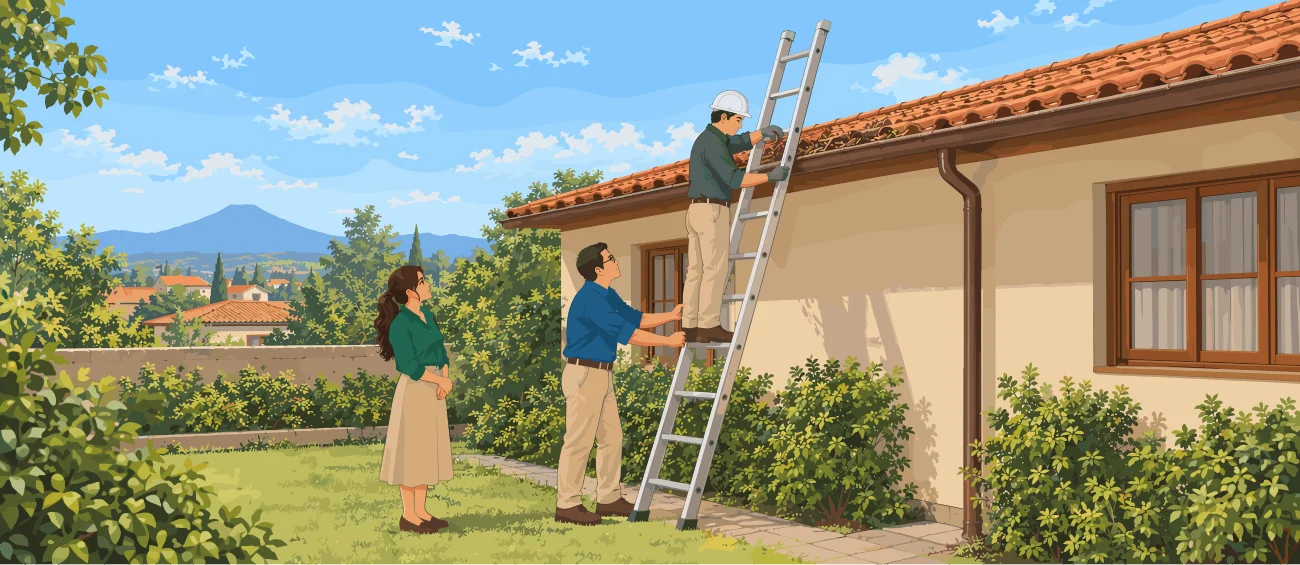
Any modifications to roofs or structures must be designed or assessed by qualified professionals beforehand.
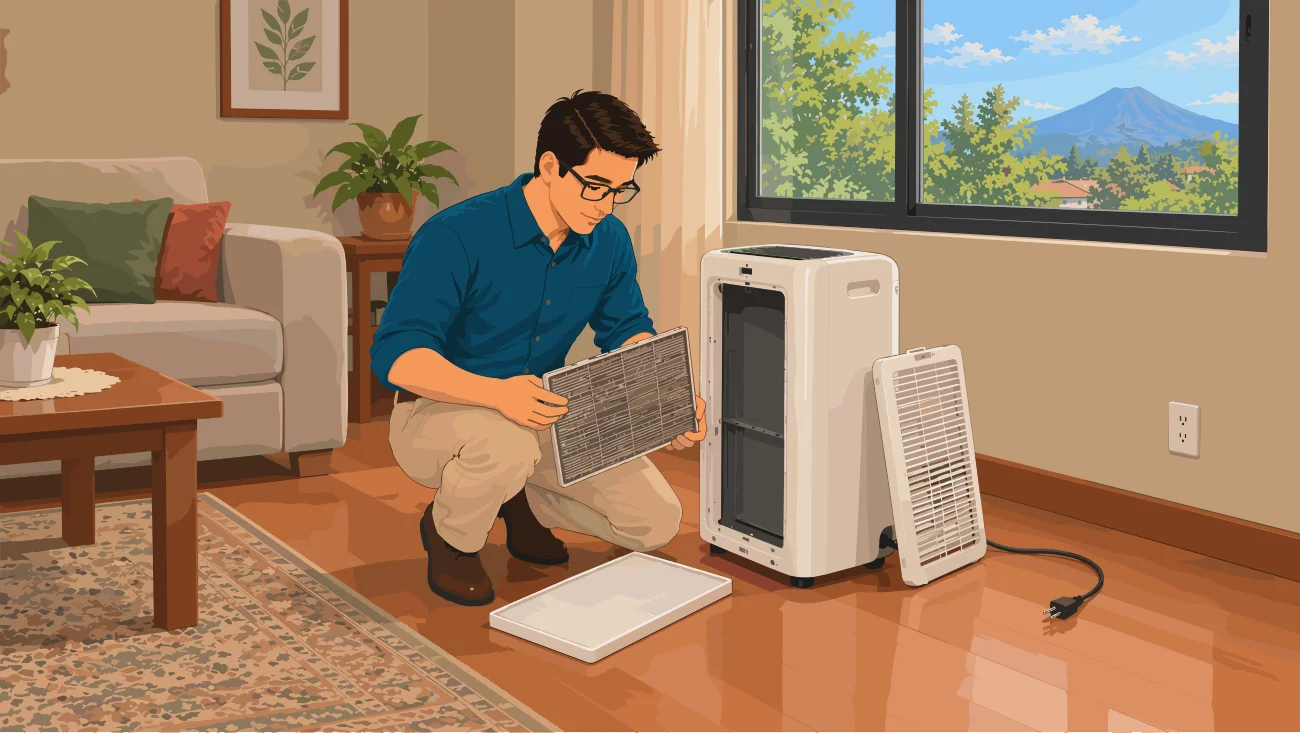
1.15Prepare ventilation and air conditioning systems
Fine ash can enter buildings through systems that draw in outside air.
Every family and every community should know beforehand:
- How to shut down or isolate the systems when applicable;
- what filters they use;
- how to replace them.
1.16Protect equipment and documentation
Ash can affect:
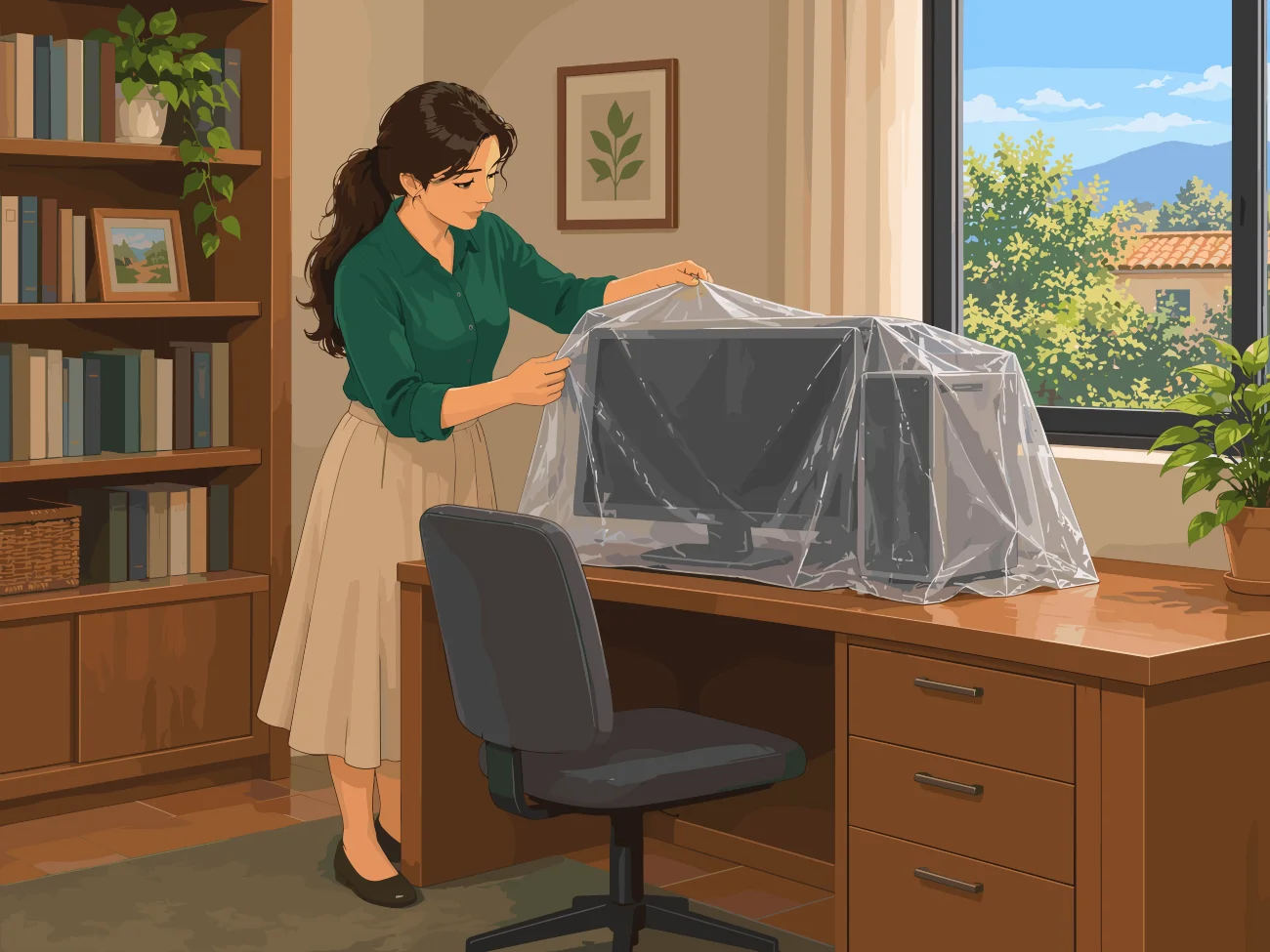
computers,

electrical equipment,
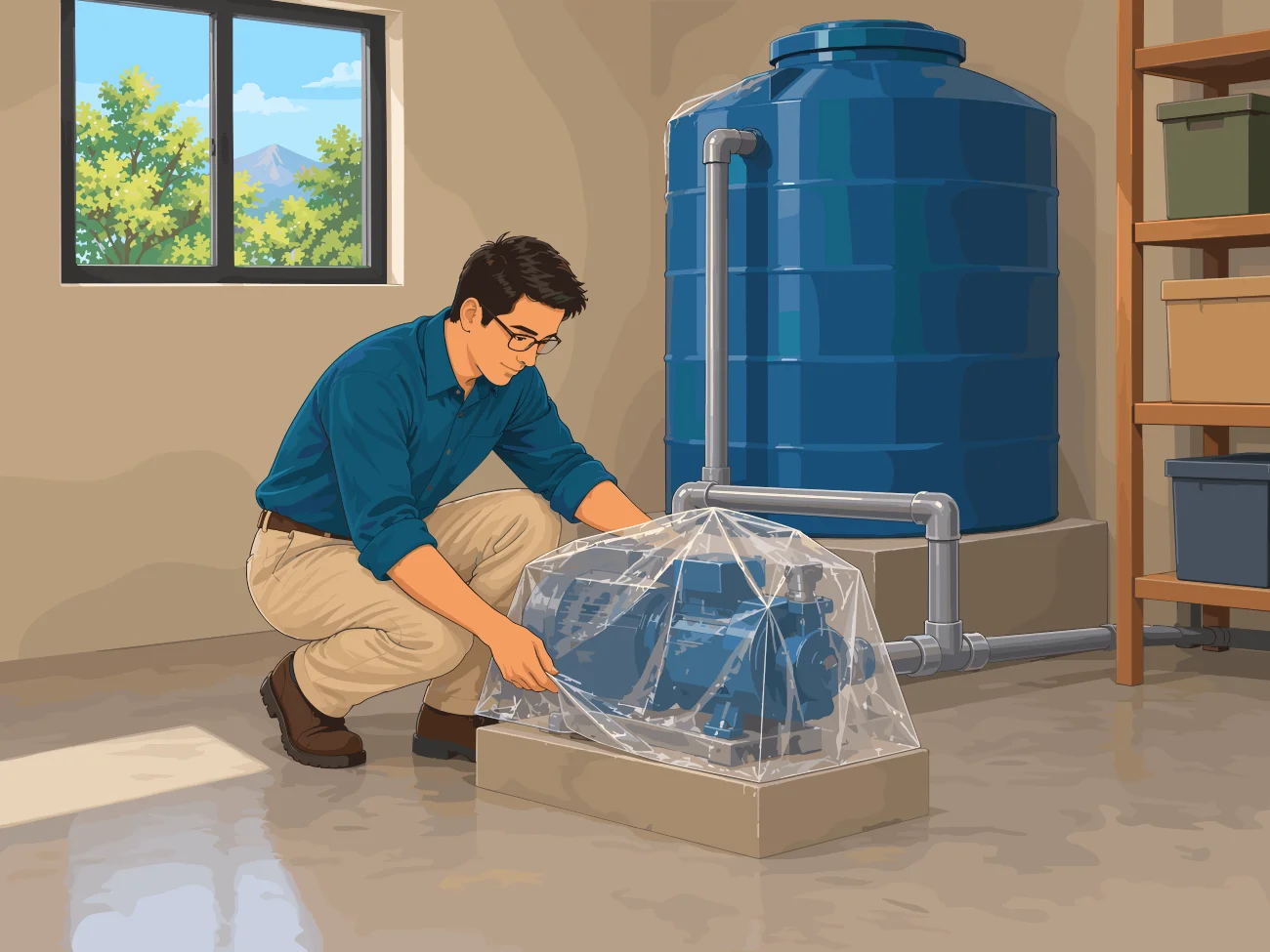
motors,
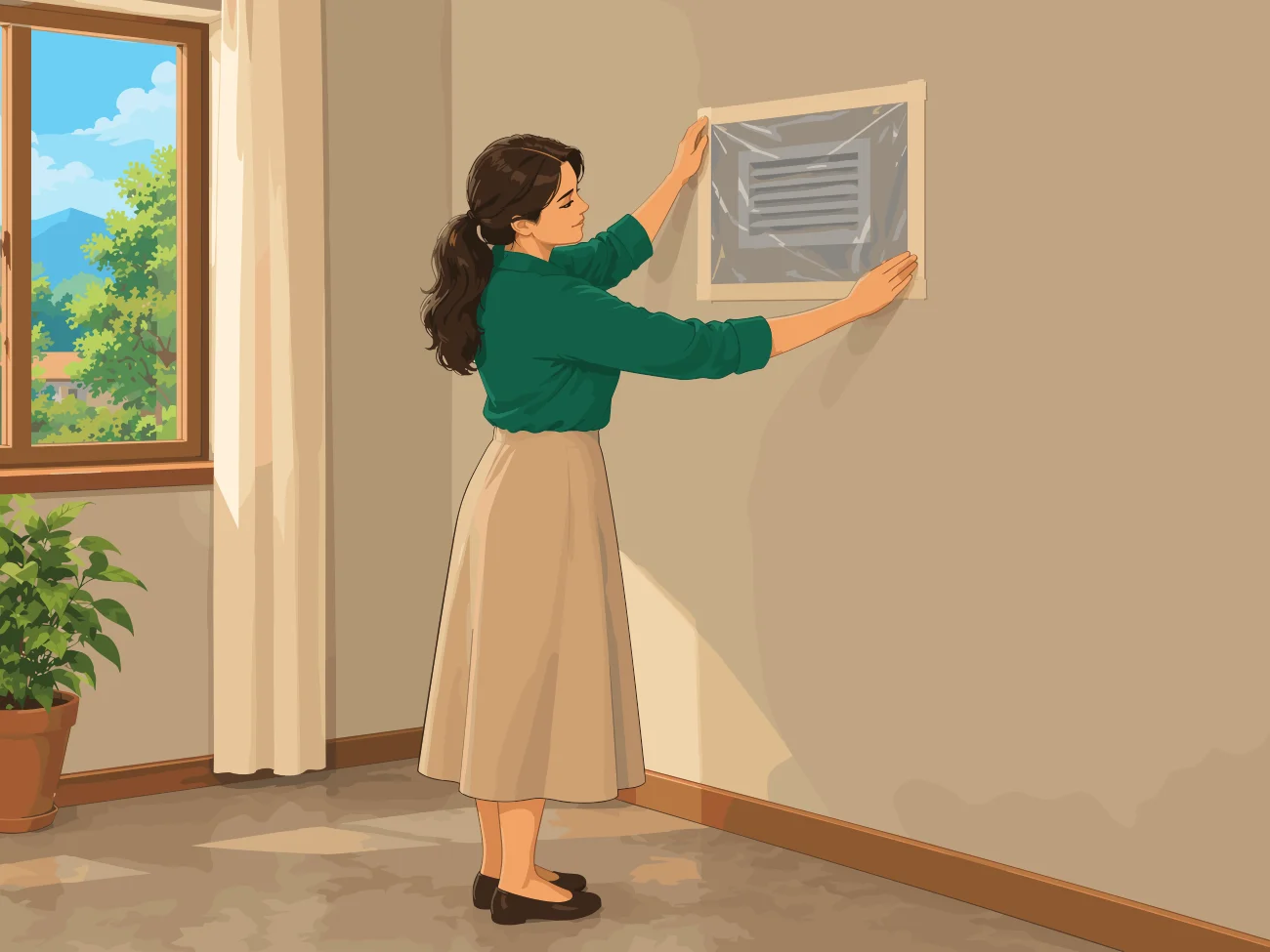
ventilation systems.
Every household and every community must determine which essential items need protection and have covers, packaging, or protected locations ready in advance.
Essential documentation must have, when possible, backup copies stored in different places or secure digital systems.
1.17Prepare vehicles
When a household or community has vehicles intended for evacuation or assistance, they must be kept operational and properly maintained.
During periods of increased volcanic activity, pay special attention to:
- sufficient fuel,
- tires,
- battery,
- lights,
- windshield wipers,
- filters,
- emergency kit,
- maps,
- means of communication.
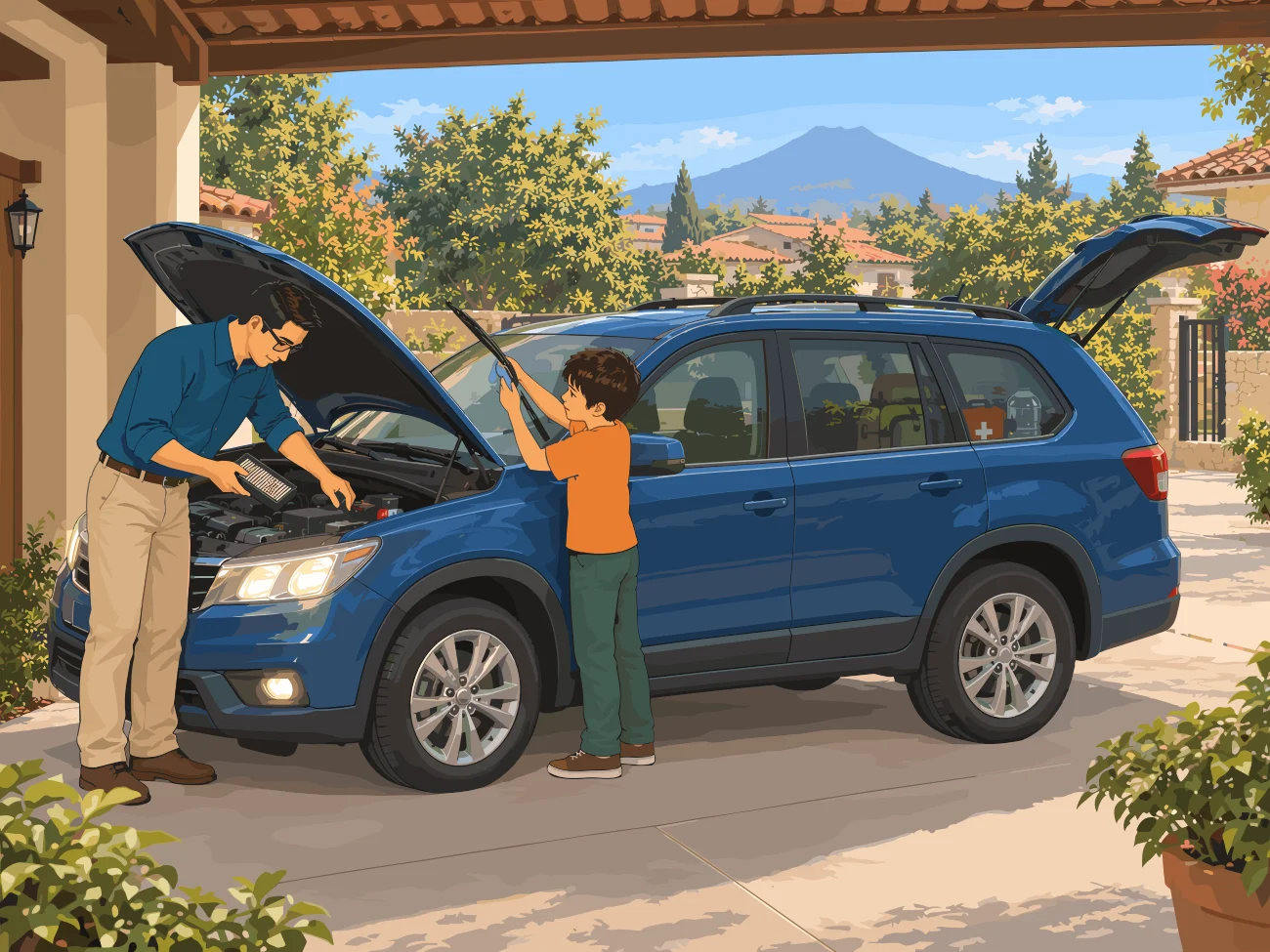
Vehicles do not replace proper planning, nor do they guarantee that a route will remain available.
1.18Preparing pets and other animals
Families and communities that house, keep, or are responsible for animals must explicitly include them in the emergency plan.
For pets, the following should be arranged in advance:
- suitable carriers,
- identification,
- leashes or harnesses,
- food,
- water,
- medications,
- veterinary documentation, when applicable,
- an evacuation destination that accepts animals.
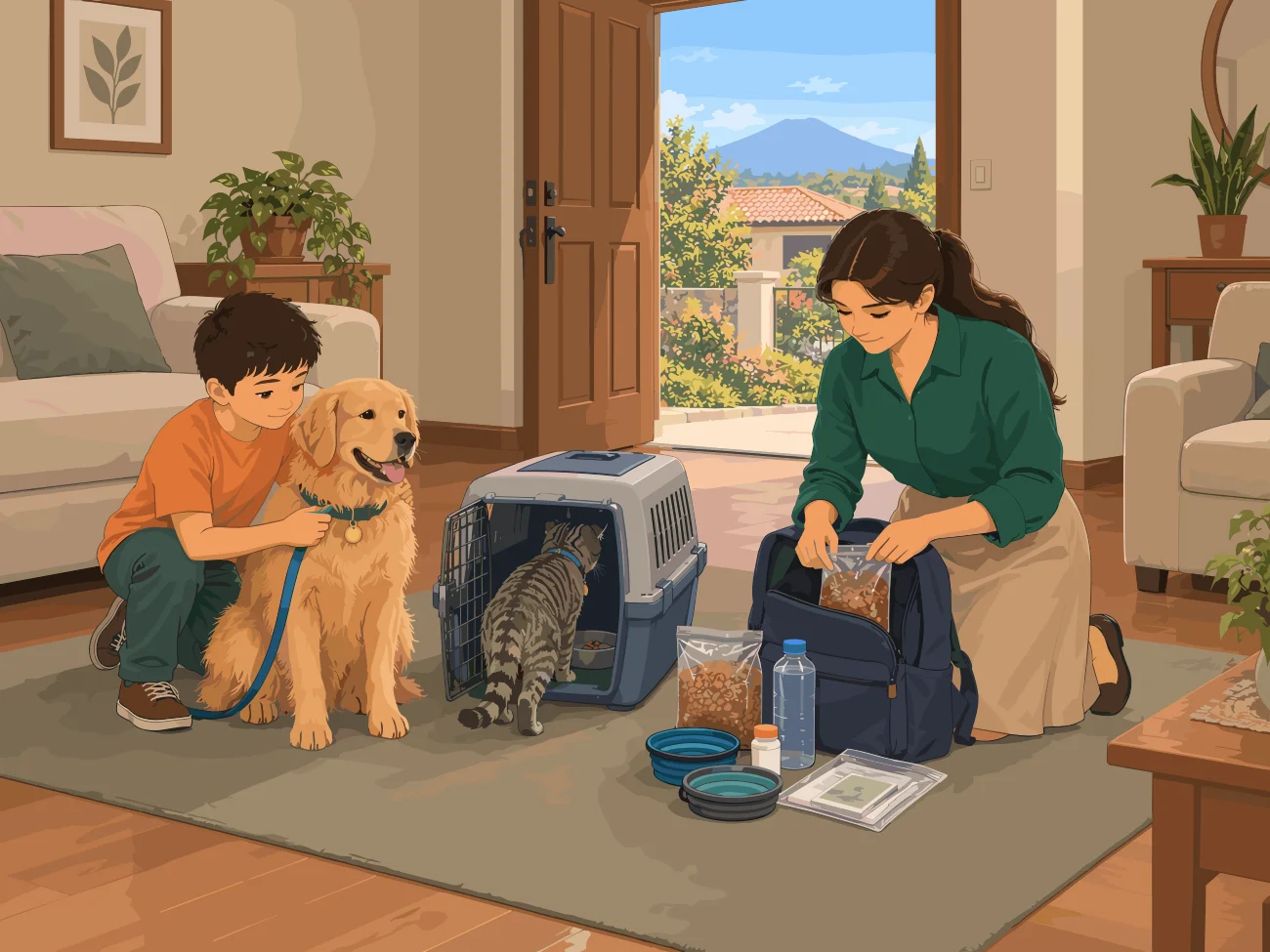
Whenever possible, animals should be accustomed to the carriers and transport procedures beforehand.
1.19Farm animals and large animals
Evacuating horses, cattle and other large animals requires specific planning and usually cannot be improvised once the emergency is already under way.
The following must be established beforehand:
- Means of transportation;
- trailers or suitable vehicles;
- leads;
- safe destinations;
- authorized routes;
- food availability;
- protected water reserves;
- mechanisms for protecting forage and food from ash.
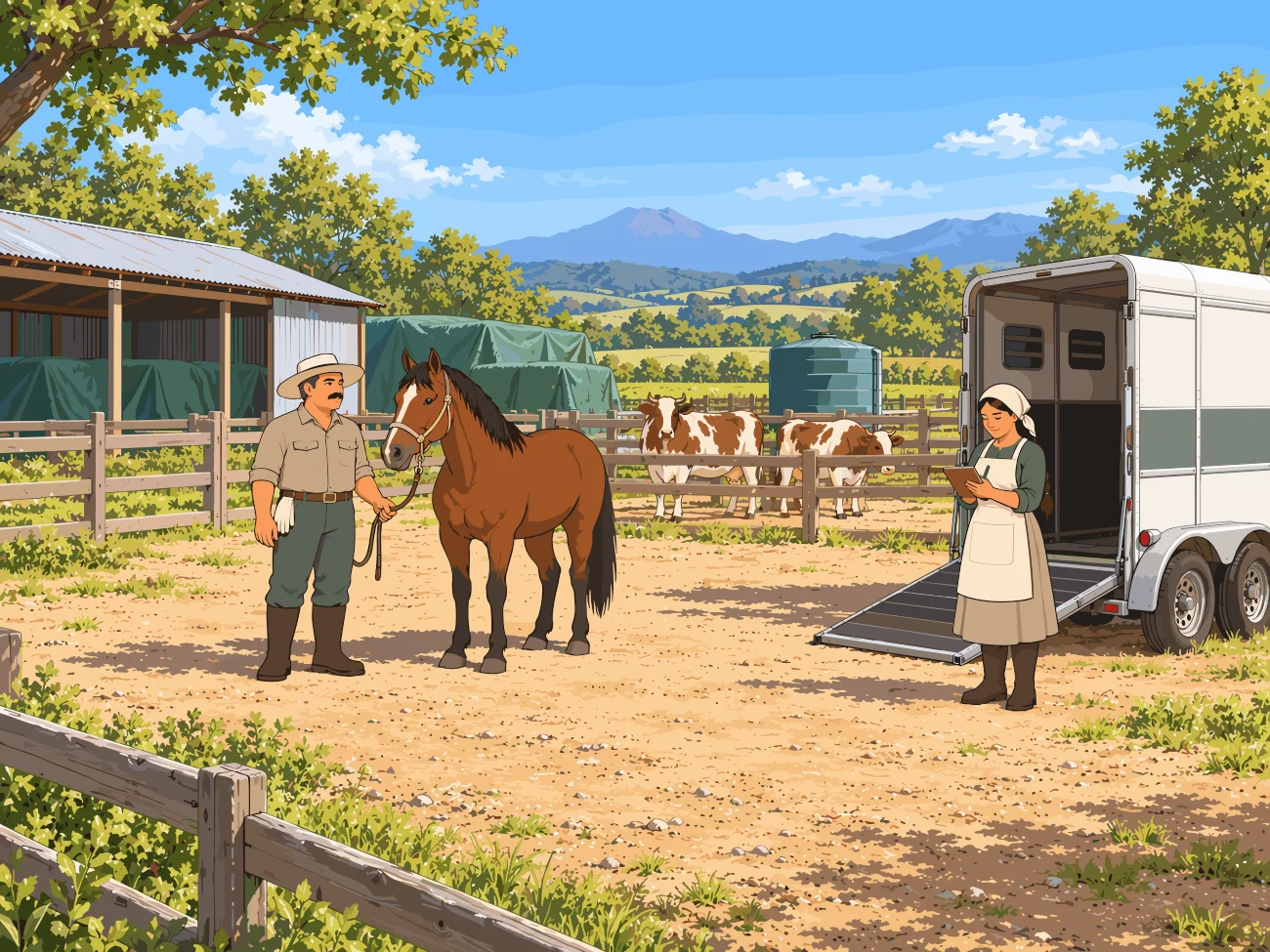
Where there is significant volcanic risk, the preventive movement of animals must be carried out in accordance with the instructions of the authorities and with sufficient advance notice.
1.20Emergency communications
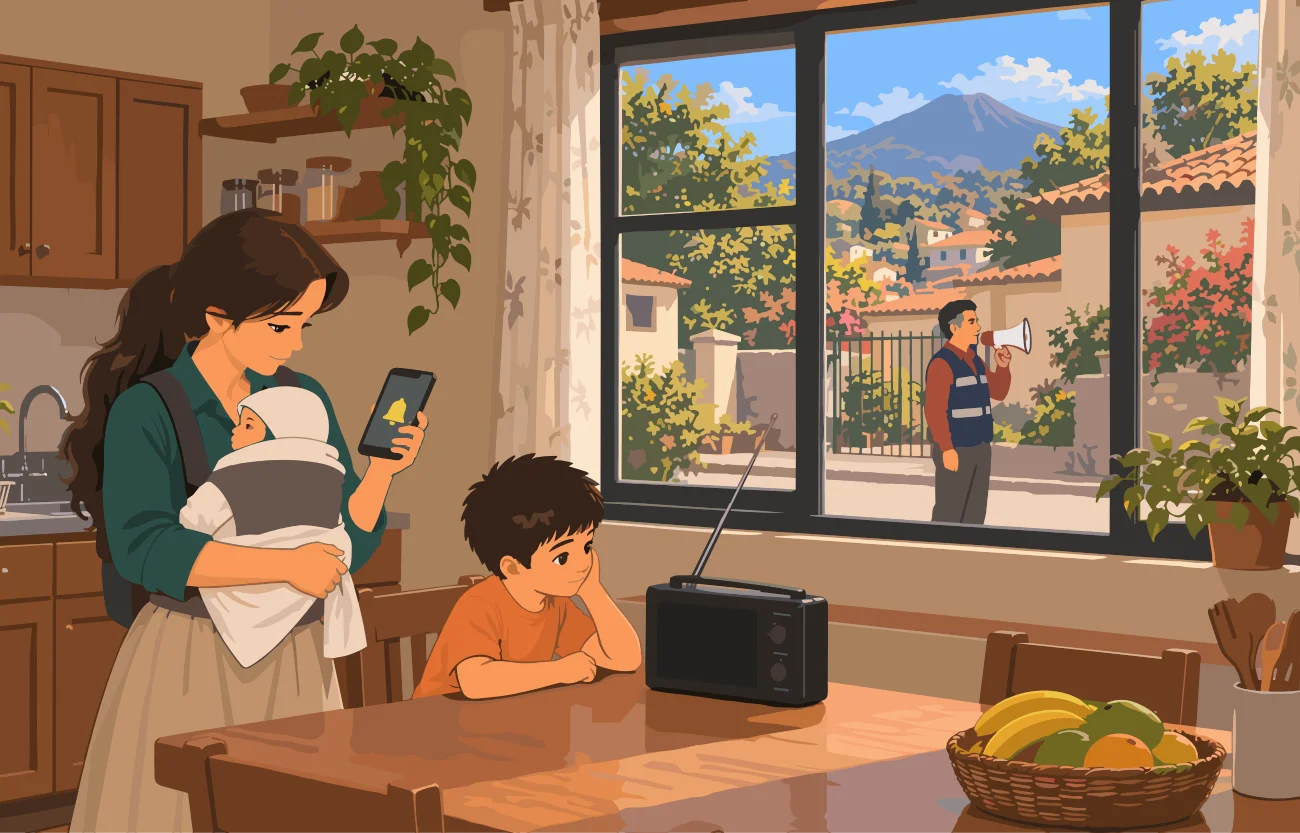
Each person, household or community must have more than one means of receiving information.
These may include:
- Mobile phone service;
- radio;
- official alert systems;
- official apps;
- family or community messaging;
- community communication networks;
- other means established by the authorities.
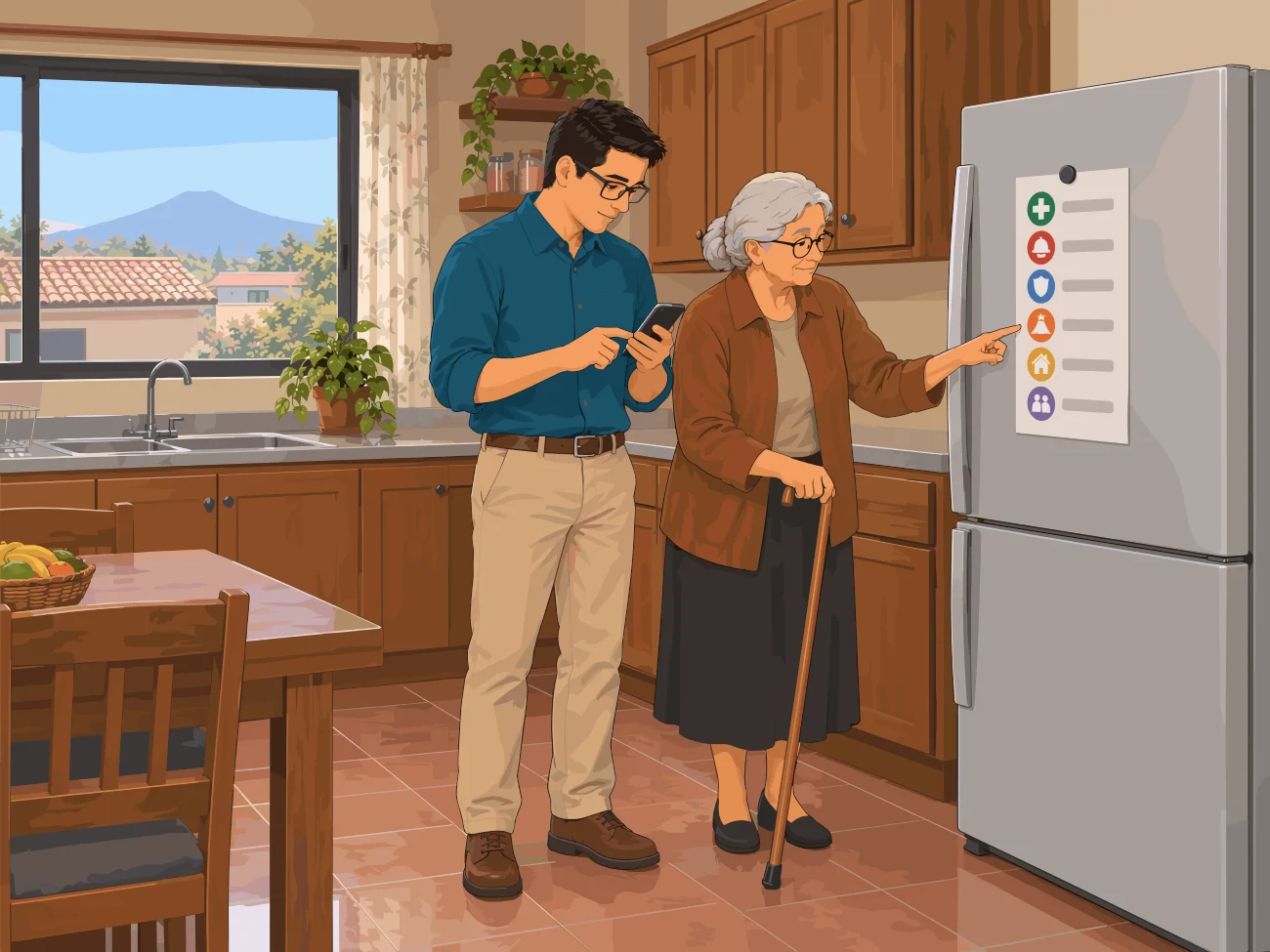
An up-to-date list should be kept of:
- Emergency services;
- civil protection;
- volcano monitoring agencies;
- local authorities;
- hospitals;
- fire department;
- police;
- family and community leads.
1.21Plan for reunification and contact
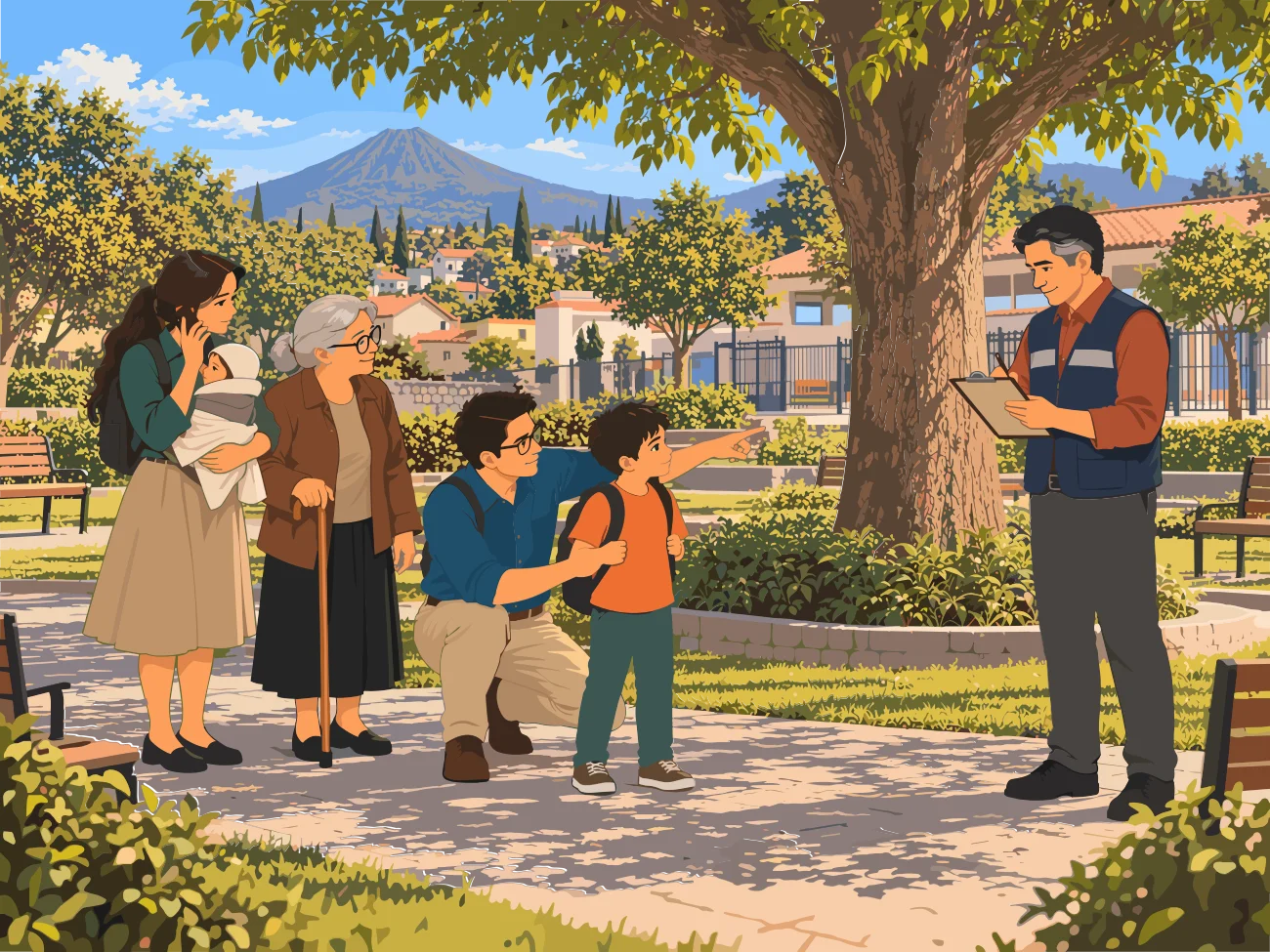
Every family and every community must plan for what will happen if an emergency happens while some of its members are away from the home or the community.
It is recommended to establish:
- A main meeting point;
- one or more alternate meeting points;
- leads responsible for registration;
- procedures for children or dependent people;
- an external contact, when convenient;
- mechanisms for reporting people's status.
1.22Hold drills
Plans must be practiced.
Drills should include, when applicable:
- Alarm activation;
- internal communication;
- putting on protective equipment;
- evacuation;
- assisting vulnerable people;
- moving animals;
- the use of alternative routes;
- arrival at the meeting point;
- head count;
- communications;
- identifying failures.
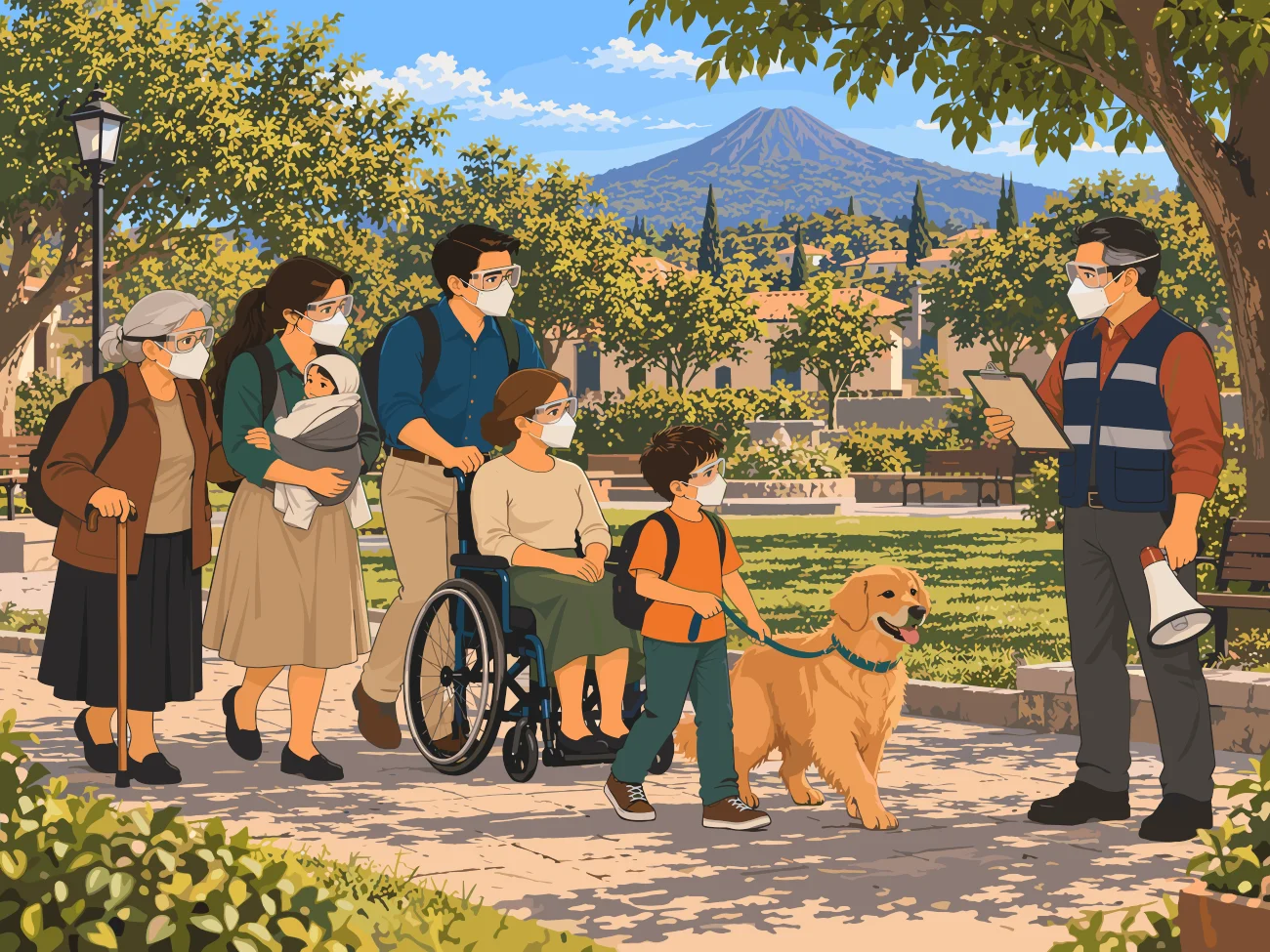
The objective is not only to evacuate quickly, but to do so safely, in an orderly manner, and in accordance with the plan.
1.23Train every member of the family and the community
Family members, neighbors and community leaders must know:
- The existing volcanic hazards;
- the alarms;
- the evacuation routes;
- the meeting points;
- who the leads are;
- which measures to take against ash;
- the correct use of respirators;
- the assistance procedures;
- the official sources of information.
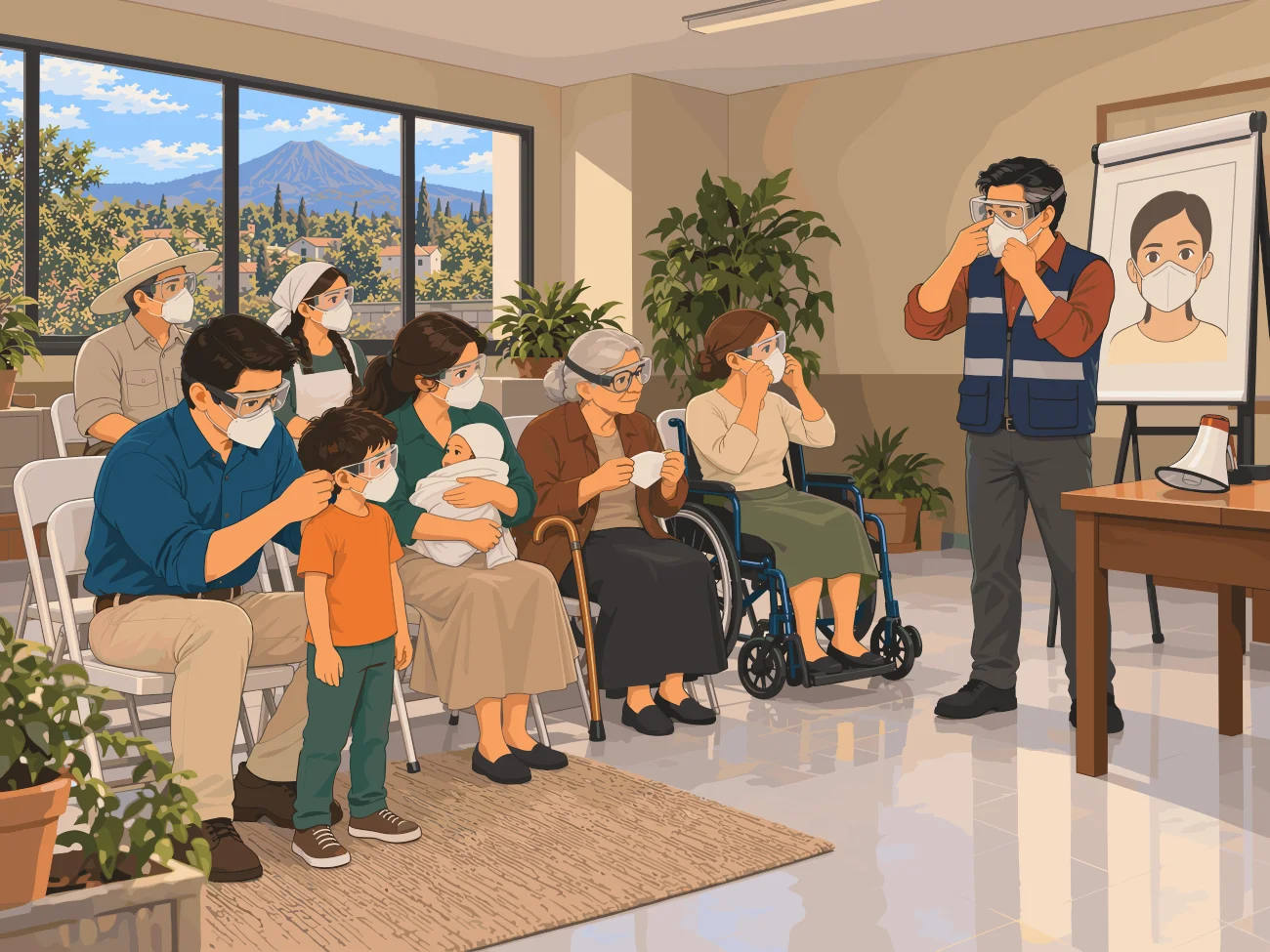
Training must be updated periodically.
Essential instructions must be understandable and, where the characteristics of the community require it, available in accessible formats or in different languages.
1.24Do not depend exclusively on visible signs from the volcano
A person without specialized knowledge cannot reliably determine how a volcanic crisis is developing by observing the crater, smoke, sounds, or any other isolated sign on their own.
Volcanoes are monitored through multiple scientific parameters, which may include:
- seismic activity,
- ground deformation,
- gas emissions,
- temperature,
- satellite observations,
- hydrothermal changes,
- visual observations,
- other instruments and techniques.
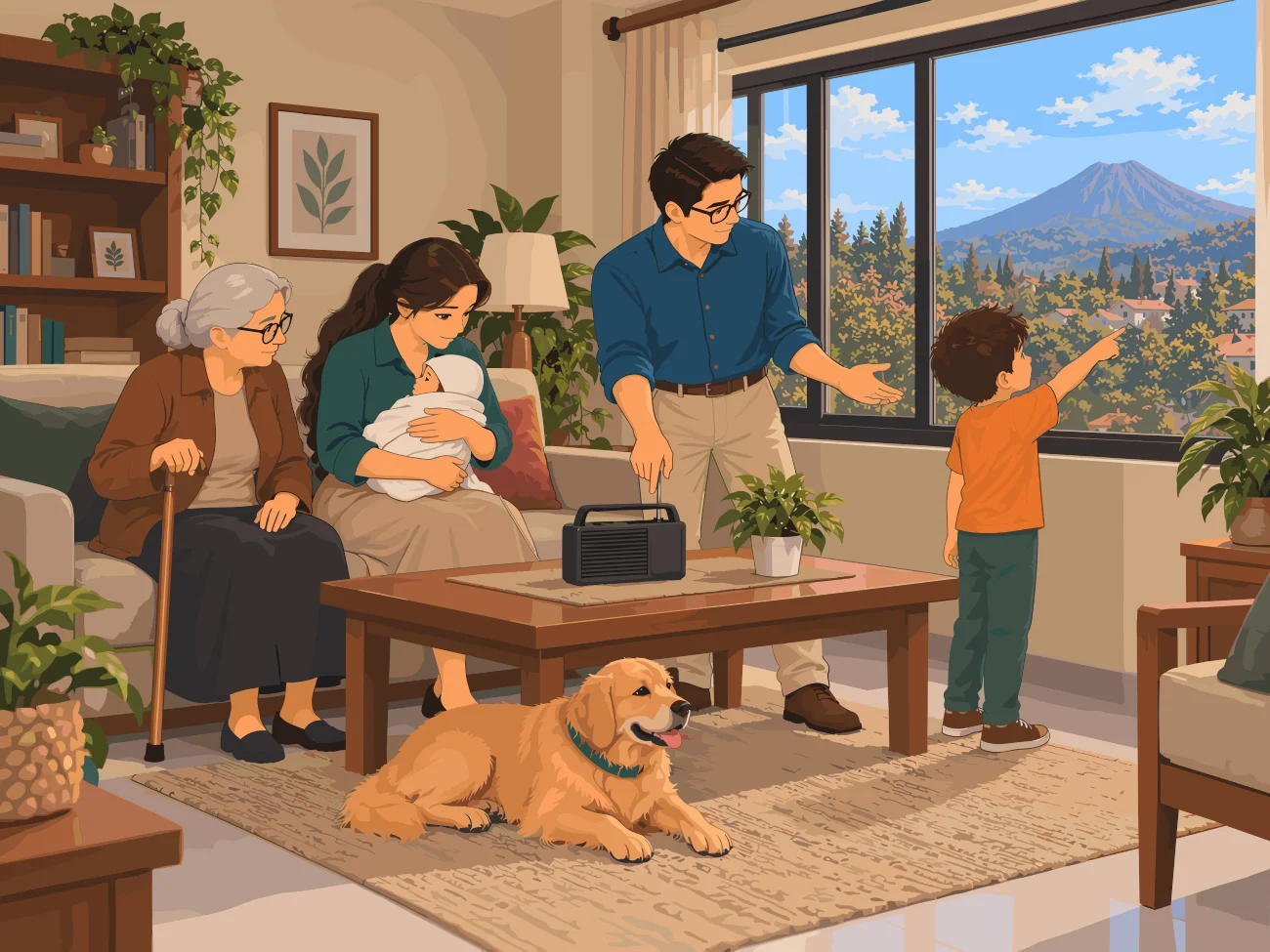
Interpretation is the responsibility of the relevant scientific agencies.
1.25Do not approach the volcano to watch the activity
When volcanic activity increases:
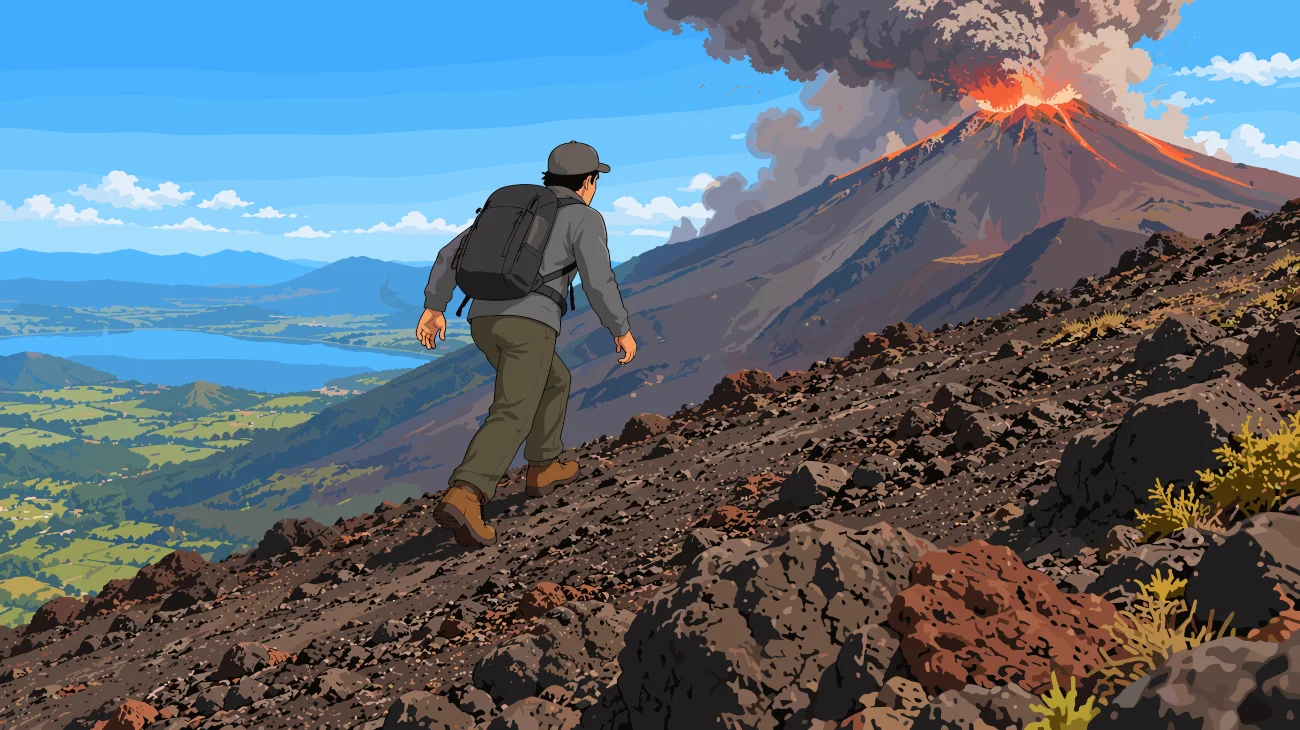
Do not approach the crater,
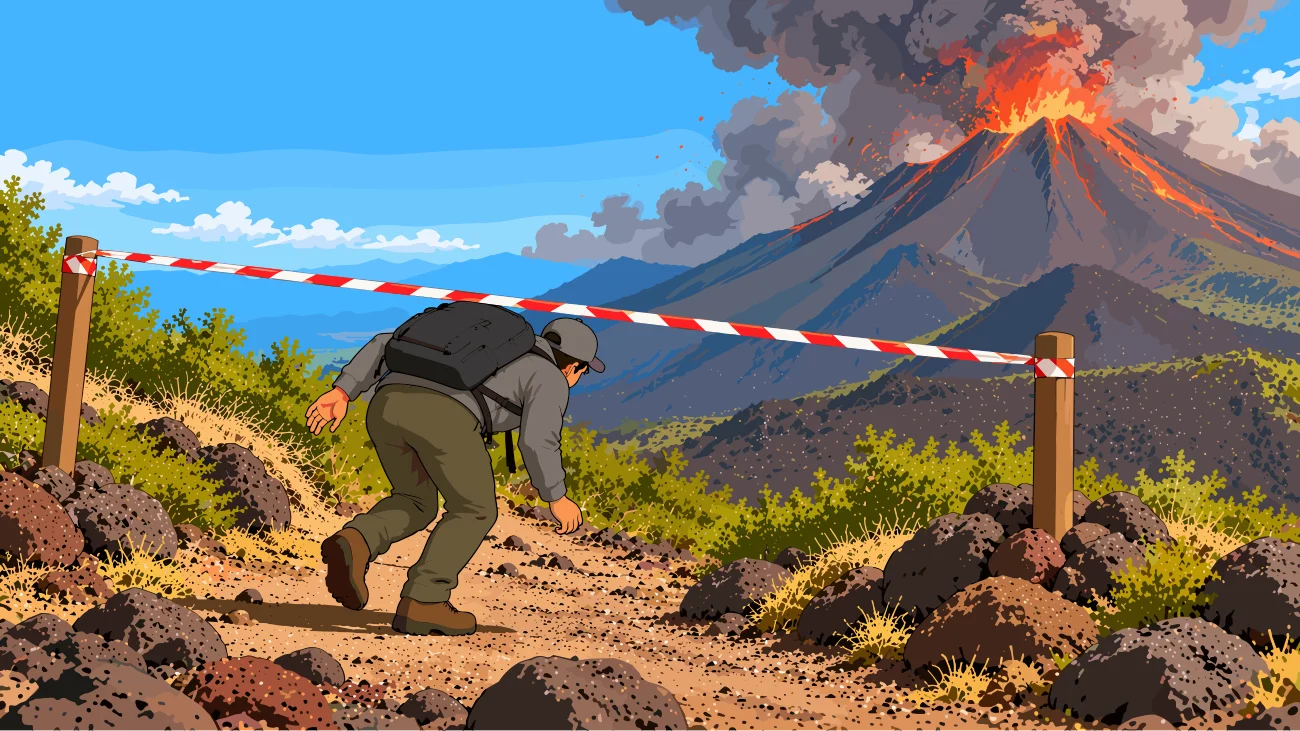
do not enter exclusion zones,
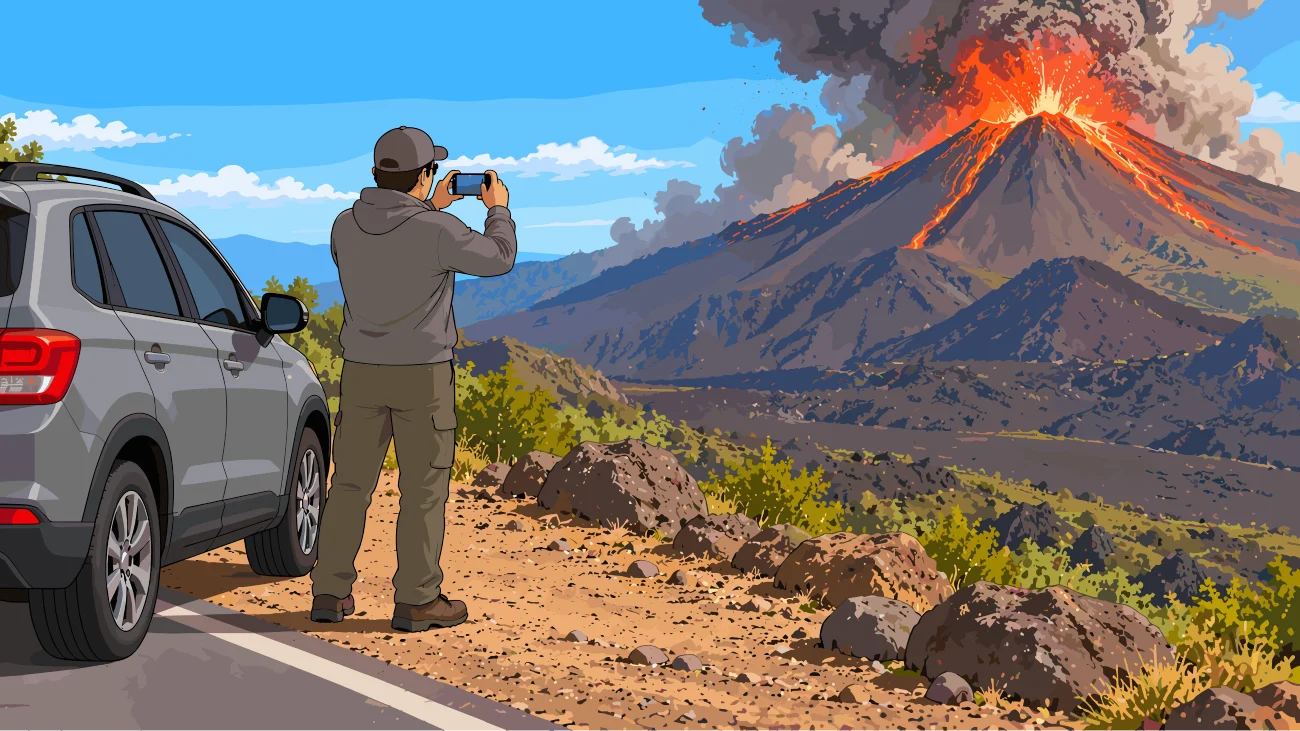
do not stop along roads to watch or take photographs,
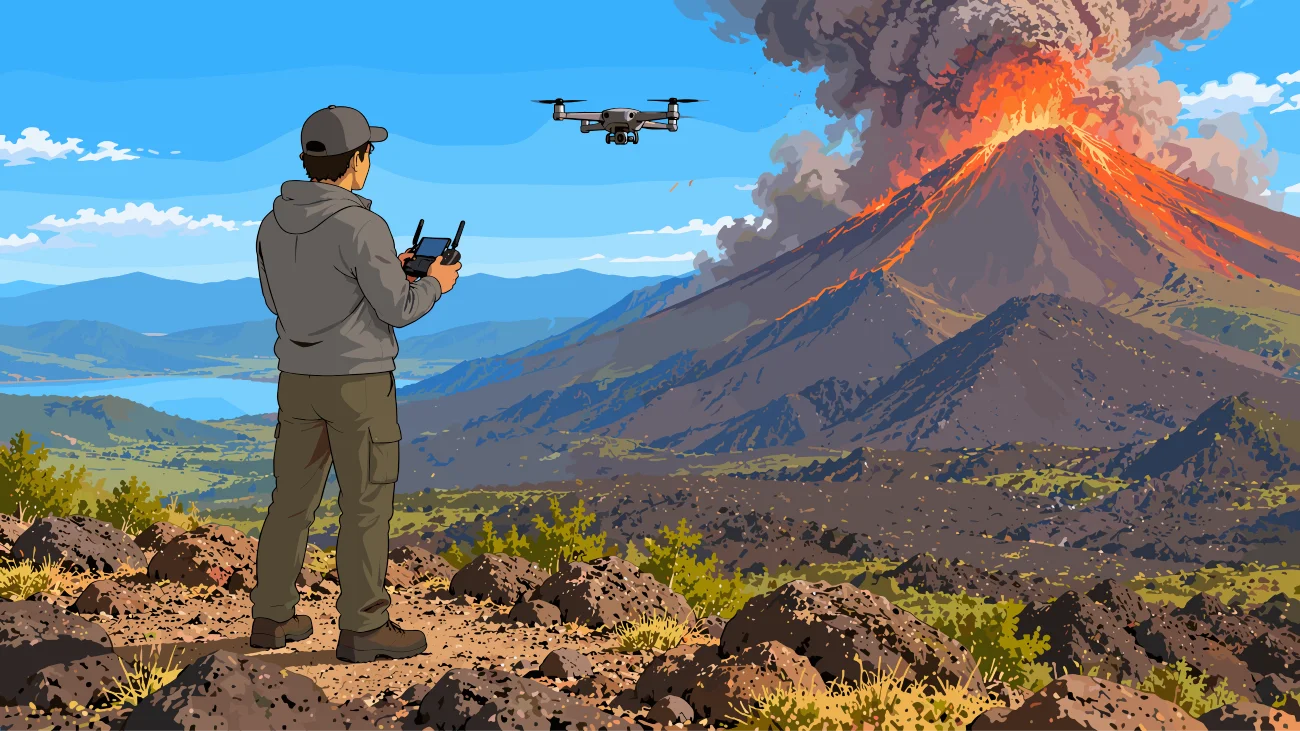
do not use drones if the authorities have prohibited it,
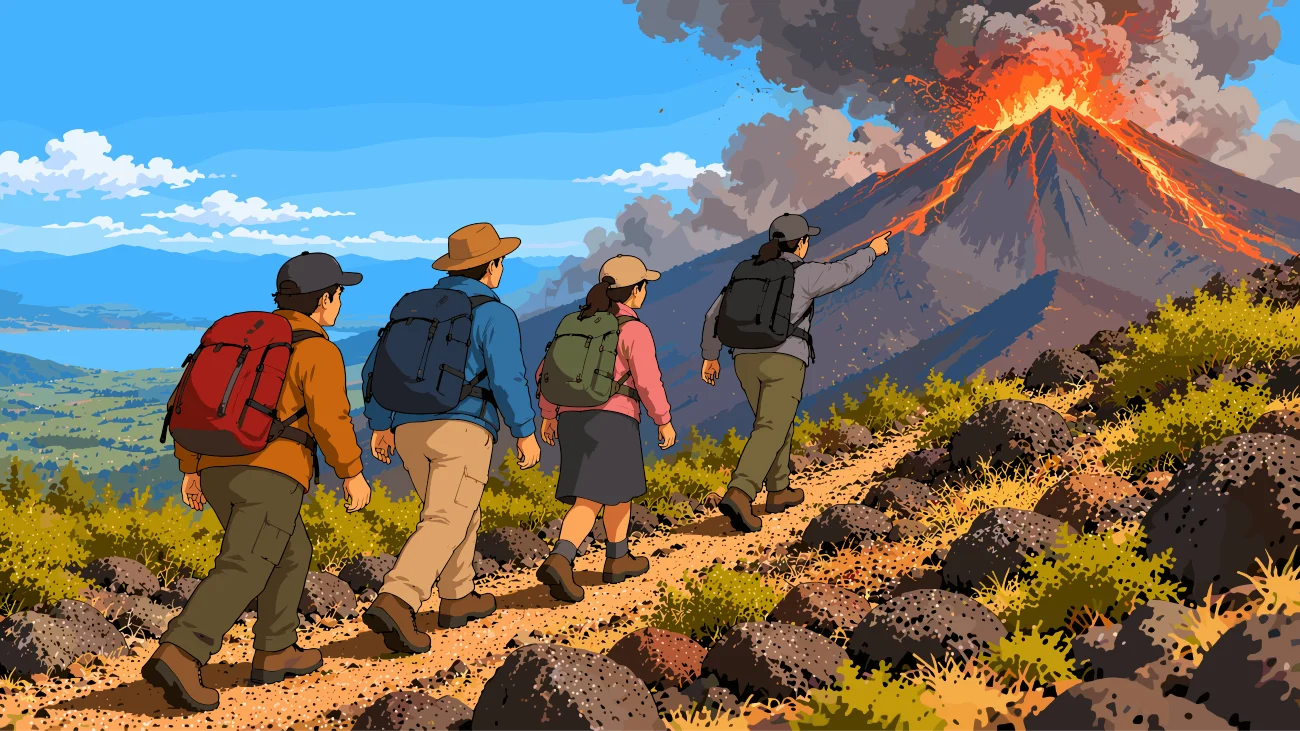
do not organize excursions,
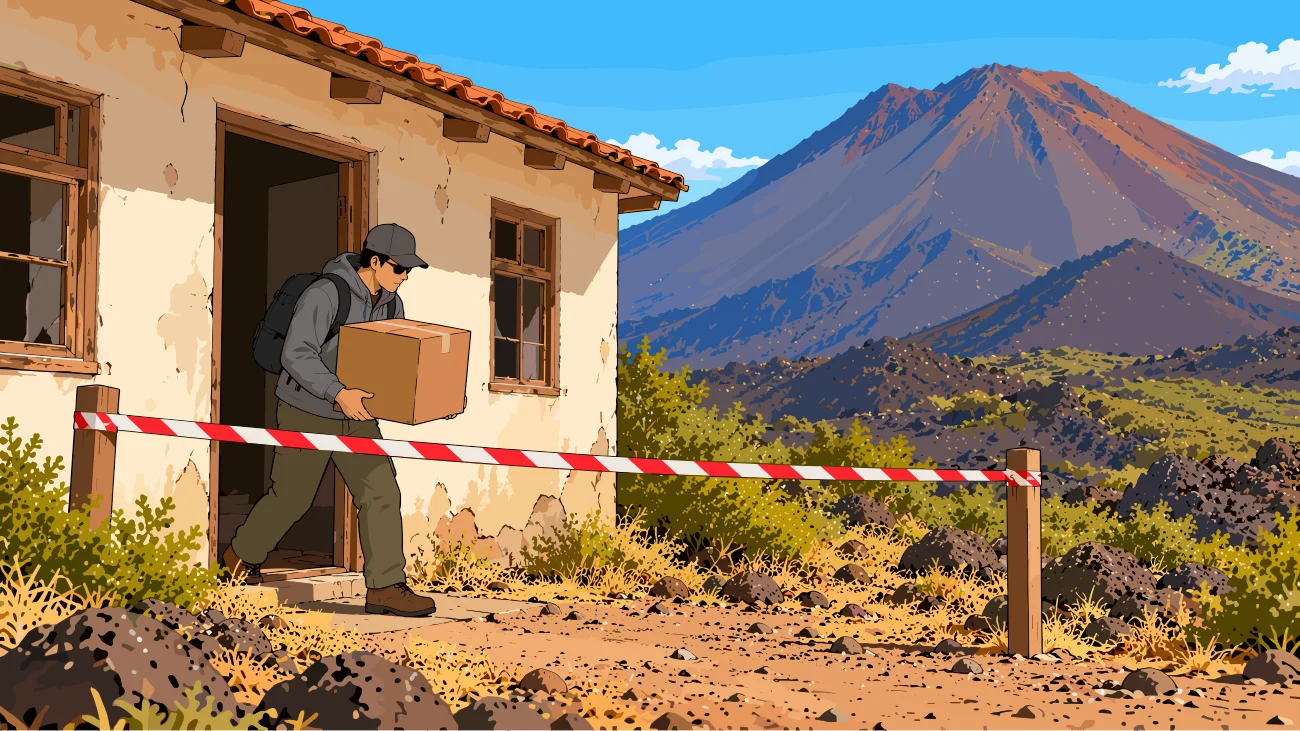
do not enter restricted areas to recover belongings.
1.26Take action when the alert level changes
When the authorities raise the alert level, each family and each community must immediately review its plan and take the corresponding measures.
Depending on the official instructions, this may involve:
- Following information more closely;
- contacting leads;
- suspending certain activities;
- preparing means of transportation;
- preparing vulnerable people;
- protecting water and equipment;
- moving animals as a precaution;
- distributing protective equipment;
- preparing the home and community spaces for ashfall;
- carrying out a preventive evacuation.
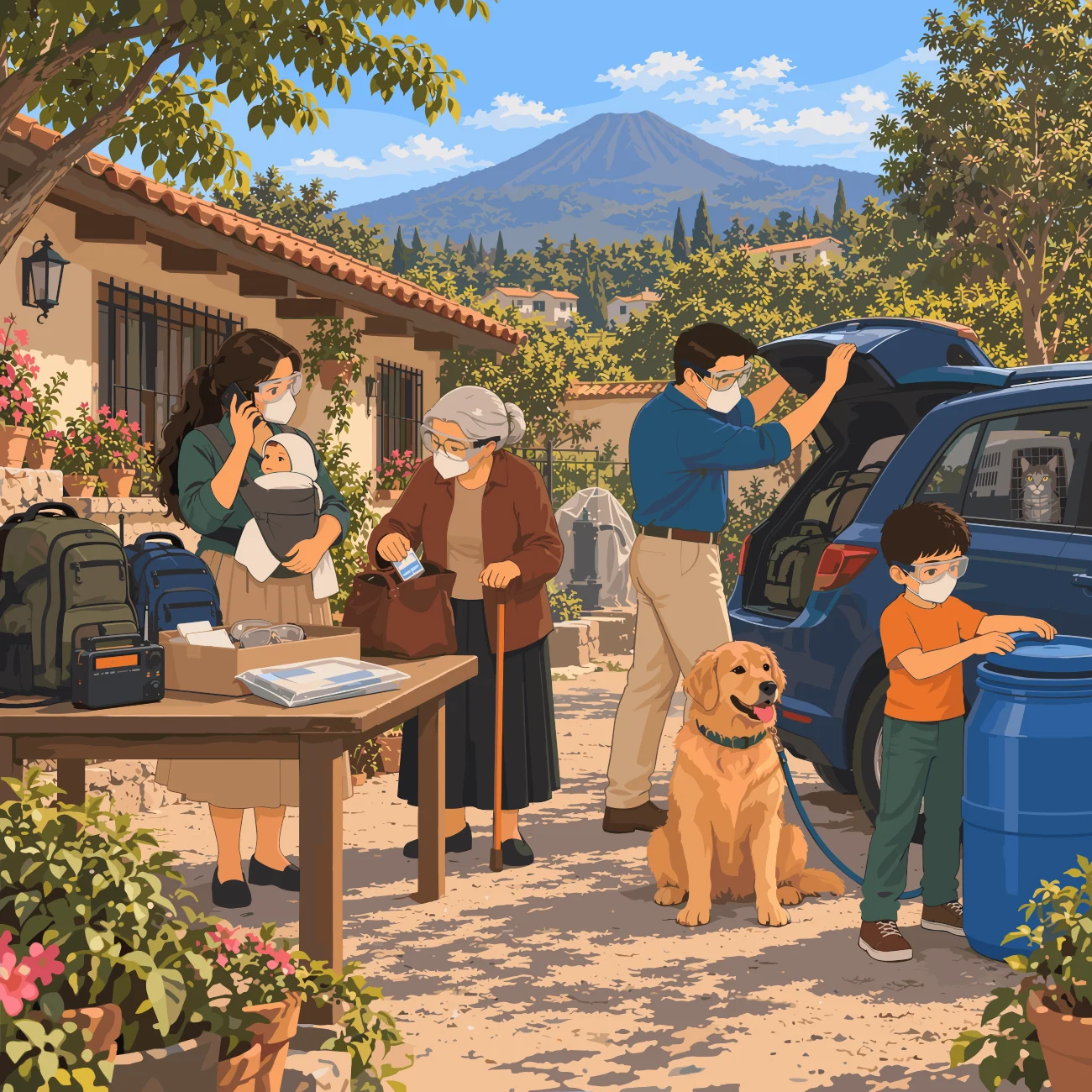
A particular color or alert level does not, by itself, mean that every family and community must evacuate.
The decision will depend on the official system, the location, the specific hazard, and the authorities' instructions.
1.27If the authorities order an evacuation
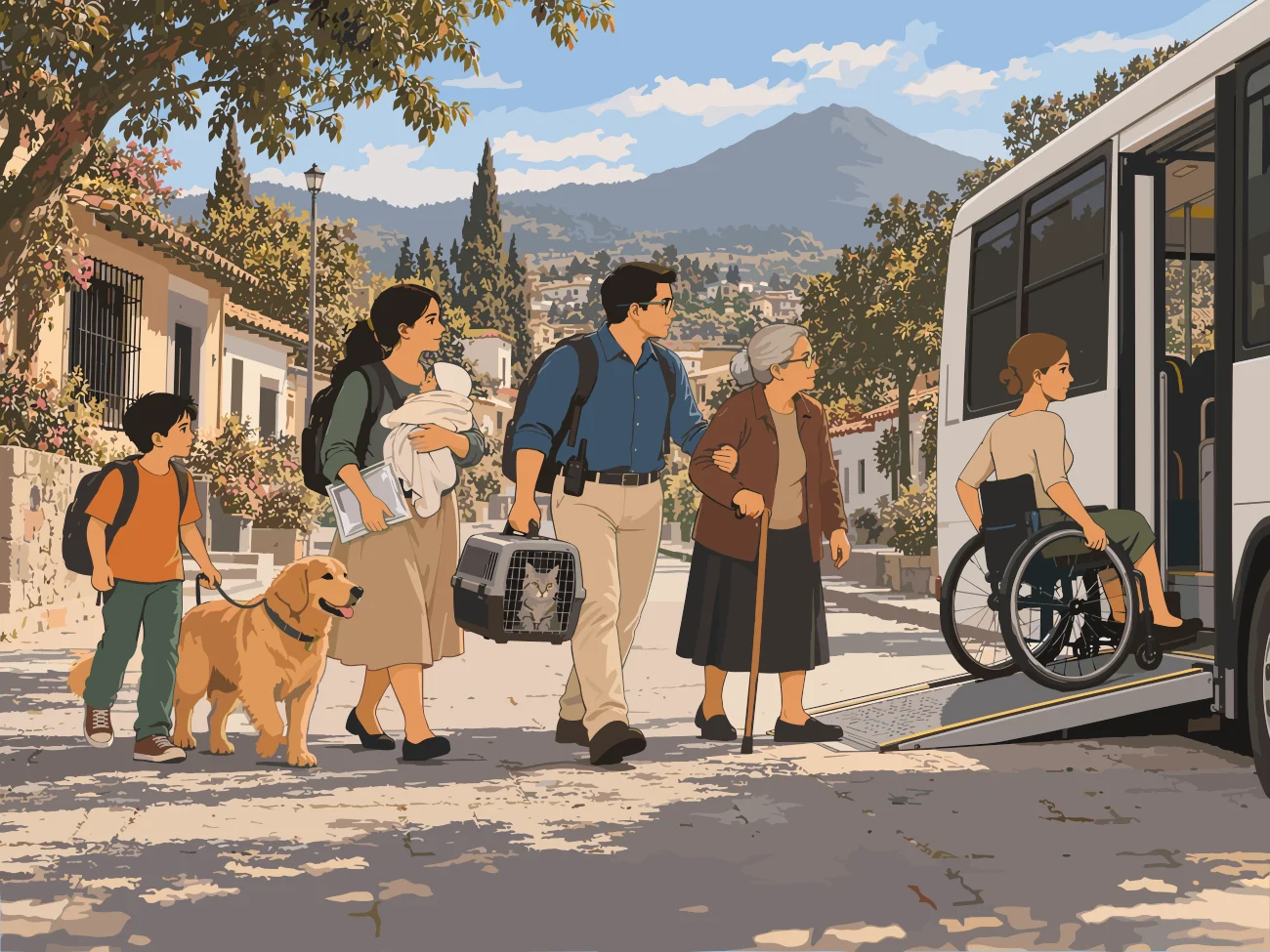
Every household and every community must be ready to act immediately. An official evacuation order is not the time to begin designing the procedure.
By then, the following must already be defined:
- leads,
- routes,
- transportation,
- destinations,
- assistance for vulnerable people,
- essential documentation,
- supplies,
- procedures for animals,
- communication systems.
1.28Fundamental principle
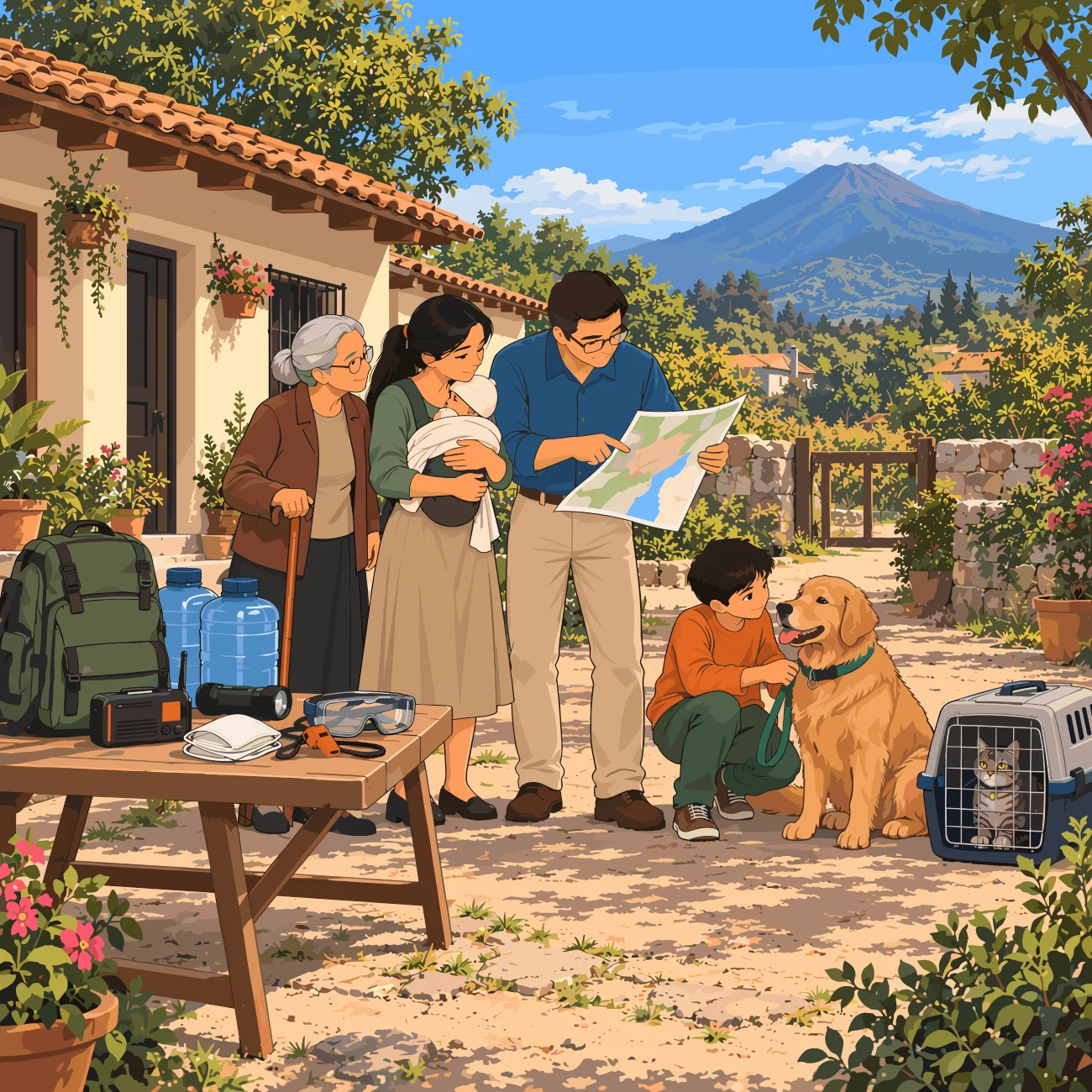
Preparing for a volcanic eruption does not consist of trying to individually predict when an eruption will happen, or improvising once the volcano begins to show activity.
It consists of knowing the hazards, staying informed, preparing people, organizing the household and the community, having the necessary resources, and knowing exactly what to do when the authorities issue instructions.
A prepared household or community must be able to answer four fundamental questions:
- Which volcanic hazards could affect us?
- How will we receive a reliable alert?
- When and by which route must we evacuate or shelter-in-place?
- How will we protect and assist everyone in our care?
Prevention and preparedness carried out during normal periods are among the most important tools for reducing injuries, loss of life, and damage during a future volcanic emergency.
Final reminder
BEFORE A VOLCANIC ERUPTION:
- Know the risk;
- consult the official maps;
- identify the evacuation routes;
- also prepare a shelter-in-place plan;
- organize leads and alternates;
- prepare supplies;
- protect water and equipment;
- have suitable respiratory and eye protection ready;
- plan assistance for vulnerable people;
- include animals in the plan;
- hold drills;
- stay informed through official sources.
And, above all:
Downloads
© 2026 by Centro del Reino de Paz y Justicia is licensed under Creative Commons Attribution-NonCommercial-NoDerivatives 4.0 International (CC BY-NC-ND 4.0). To view a copy of this license, visit creativecommons.org/licenses/by-nc-nd/4.0.