Phase 3: After — Safety, assessment, evacuation, and initial recovery
When the main shaking of an earthquake stops, the emergency has not necessarily ended. Aftershocks may occur, causing additional materials to come loose or the collapse of previously weakened structures.
Therefore, during the first few minutes and in the hours that follow, it is essential to act with caution, assess your surroundings before moving, and follow the instructions of the authorities and emergency services.
The priority remains: protect life.
After the shaking
Assess – Protect yourself – Evacuate if necessary – Stay informed.
3.1When the shaking stops
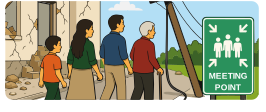
When the shaking stops, don't automatically rush toward the exit. Quickly scan your surroundings and check for any immediate dangers.
Pay close attention to

- injured people;
- damage to walls, columns, beams, ceilings, or stairs;
- broken glass;
- fallen objects;
- unstable furniture or other items;
- blocked exits;
- smoke or fires;
- the smell of gas;
- damaged or downed power lines;
- water leaks;
- suspended objects that could fall.
If you are in a safe place and there is no immediate danger, remain calm and figure out the safest route before moving.
If evacuation becomes necessary

Walk, do not run

Use the evacuation routes that remain safe

Do not use elevators

Avoid pushing and crowding

Help those who need assistance without putting yourself in unnecessary danger

Keep children and the members of your group together

Proceed to the designated meeting point or the location indicated by the authorities

Take the emergency kit only if it is immediately available and you can grab it without delaying a necessary evacuation
Once outside, stay away from damaged buildings, facades, balconies, ledges, walls, poles, power lines, and other objects that could fall.
Do not return to a damaged building until the authorities or qualified professionals indicate that it is safe to do so.
3.2Prepare for aftershocks
Aftershocks may occur after the initial shaking. Some may be strong enough to cause objects to fall or to worsen existing damage.
If another tremor begins
DROP – COVER – HOLD ON

DROP
Get down to the ground immediately.

COVER
Protect your head and neck.

HOLD ON
Hold on until the shaking stops.
After the aftershock

If you are already in an open, safe area, stay away from buildings, poles, power lines, walls, and other objects that could fall.


Do not enter damaged structures.

A building that remained standing after the initial shaking may have sustained damage that is not immediately apparent.
3.3Children after the earthquake
Children need physical protection, supervision and emotional support.
When the shaking stops
Check quickly for visible injuries
Keep them close to a responsible adult
Do not let them walk alone among debris, broken glass, wires or other hazards
Wear sturdy, closed-toe shoes whenever possible
During an evacuation, hold their hands or provide them with appropriate assistance based on their age and the conditions in that location
Do not allow them to go back to retrieve toys, pets, or other items
Keep them away from damaged structures and from rescue operations
Explain to them what they should do in simple terms

You can use instructions such as

"Stay with me."
"Let's walk together."
"Don't touch anything on the floor."
"If it shakes again, we will take cover again."
Avoid sharing alarming information or unnecessarily exposing children to scenes that could increase their distress.
Whenever possible, provide them with simple, safe activities that help keep them calm and accompanied.
3.4Evacuating with pets
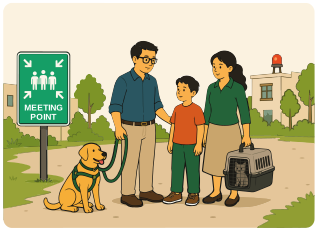
After the shaking, locate the pets when you can do so without putting yourself in danger.
Before opening doors to the outside, secure the animal to reduce the risk of it escaping.
As applicable

Put a leash and harness on the dog

Use a muzzle only when the animal needs it and is accustomed to wearing one

Place cats and other small animals in a suitable carrier

Keep pets under control throughout the evacuation
Do not allow them to walk freely in areas where there may be:

Glass

Sharp objects

Debris

Spilled substances

Electrical cables

Hot surfaces

Other hazards
Noises, sirens, people, other animals, and aftershocks can trigger unpredictable reactions even in normally calm pets.
Do not return to an unsafe building just to look for a pet.
When conditions allow you to search without putting yourself at serious risk, do so with caution.
3.5Evacuating crowded places
When movement ends in a shopping mall, supermarket, cinema, theater, stadium, place of worship, school, train station, auditorium, or other crowded place, avoid rushing into a crowd.
Follow the instructions of staff, first responders, emergency services, or authorities.
During the evacuation
Walk, do not run
Do not push
Stay alert for suspended or damaged objects that could fall
Do not use elevators
Do not try to cut through crowds
Check for broken glass, debris, and fallen objects
Keep children and people who need assistance together
Be prepared to take cover again if an aftershock begins

If you find yourself in a very dense crowd

Avoid trying to force your way against the flow of people

Try to move gradually toward a less crowded area whenever possible

Keep your arms bent in front of your torso to maintain breathing space

Maintain your balance and avoid sudden movements

If you fall and cannot get up immediately, protect your head and neck, and try to turn onto your side or in a compact position until you can stand up
3.6If there is a risk of a tsunami
An earthquake that occurs in a coastal area can trigger a tsunami.
If you are near the coast and…

The earthquake was strong

The shaking lasted a long time

You receive an official tsunami warning

You notice an unusual retreat or rise in the sea level

You hear an unusual noise coming from the sea

The authorities order an evacuation
Move away from the coast immediately!
Do not necessarily wait for an official warning if there are obvious natural signs of a possible tsunami.
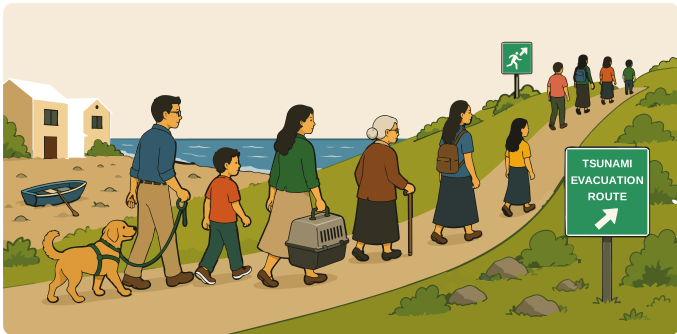
Head inland or to high ground following the marked evacuation routes. Do not go near the coast to observe the sea.
If it is not possible to reach higher ground, use a structure specifically designated or deemed suitable by the authorities for vertical evacuation, and proceed to the indicated level.
Do not independently establish a universal distance or height as a guarantee of safety. Evacuation zones depend on the topography, the characteristics of the coastline, and the plans established for each location.
Do not return to the coast after the first wave. A tsunami can consist of several waves separated by long intervals.

Stay in the safe zone until the authorities officially announce that the danger has passed.
3.7People trapped under debris
If you are trapped
Stay as calm as possible.
Avoid unnecessary movements that could dislodge unstable debris.
Protect your nose and mouth from dust by wearing a mask or, if one is not available, a piece of clothing.
Do not light matches, lighters, candles or any other type of flame.
Do not tamper with electrical systems.
Use a whistle if you have one.
Periodically tap a pipe, wall, or other object that can carry sound.
Shout only when necessary to attract the attention of rescuers, and try to conserve energy.
Use your phone to call for help or report your location if you have a signal and are able to do so (remember to conserve the battery as much as you can).
Report, when possible, how many people are trapped and any hazards you can identify.


Do not light matches or lighters

Do not tamper with electrical systems
Do not attempt to move heavy or structural items if doing so could cause the debris to shift.

If you are injured, try to control any visible bleeding by applying direct pressure whenever possible.
Be prepared for possible aftershocks.
3.8Help for people who are trapped
The first people to reach an injured person after an earthquake may be family members, neighbors, bystanders, or members of the community itself. However, a rescue carried out without assessing the risks can result in more casualties.
Before you try to help:
Observe – Assess – Do not become another victim.
Do not enter a building that has sustained significant damage, is at risk of collapse, is on fire, has a gas leak, has live electrical wires, or poses other serious hazards.

If a trapped person is visible
Communicate with the person.
Determine, to the extent possible, whether they are conscious and injured.
Notify emergency services immediately.
Provide the exact location.
Maintain verbal contact with the person.
Reassure the person.
Instruct the person to avoid unnecessary movements.
Remove only small, loose, and clearly safe objects when necessary to provide assistance.
Do not remove elements that support parts of a structure.
Do not move beams, columns, slabs, or other structural components.
Do not use jacks, levers, or other makeshift tools to lift heavy structures unless you have received specific training and conditions allow you to do so safely.


Do not remove elements that support parts of a structure

Do not move beams, columns, or other structural components

Do not use jacks or improvised levers
Keep in mind that moving an element that appears to be isolated can affect the stability of the entire structure and cause it to collapse.

Structural search and rescue operations should, whenever possible, be carried out by trained and properly equipped personnel.

3.9First aid
After checking that the surroundings are reasonably safe
Identify the people who are injured.
Call for assistance from the emergency services when possible.
If you have first-aid training, apply it within the limits of your knowledge.
Prioritize situations that may pose an immediate threat to life.

Do not move a seriously injured person unless


There is an immediate danger there.

It is essential to provide life-saving care.

Trained personnel indicate that it should be done.

If there is significant external bleeding and it is safe for you to do so, apply direct pressure using any clean material available.

Keep the person accompanied and protected from the cold, heat, or other environmental factors while waiting for assistance.

Do not give food, drinks, or medication to a person who is seriously injured, unconscious, or in an altered state of consciousness, unless instructed to do so by medical personnel.
3.10Fires, gas and electricity
After an earthquake, fires and damage to gas and electricity systems may occur.
If you smell gas or suspect a leak

Do not light matches, lighters, candles, or other open flames.

Do not smoke.

Do not flip electrical switches.

Do not plug in or unplug appliances.

Leave the area.

Stay away.

Report the situation to emergency services or the responsible company.
Close the main gas valve only if you know how to do so, can safely access it, and local guidelines recommend doing so.

A facility that has been shut down due to a suspected leak must not be put back into service until it has been inspected in accordance with local regulations.

If you notice any electrical damage
Stay away from:

Downed cables

Exposed cables

Wet electrical systems

Sparks

Damaged panels

Damaged electrical equipment

Treat any downed power line as if it were live.

Do not touch a power line or any object that is in contact with it.

If you can shut off the power from a safe location and know how to do so correctly, follow the instructions provided for the electrical system.

Otherwise, wait for trained personnel to respond.
3.11Entering buildings after the earthquake

Do not automatically enter a building after an earthquake.

The absence of visible damage does not guarantee that the structure is safe.

When authorities have restricted access to an area or building, follow those instructions.
Before getting close
Observe from a safe distance.

Pay attention to:

Visible tilting of the building

Partial collapses

Significant cracks

Damaged columns or beams

Structural distortions

Affected stairs

Cracked or unstable balconies

Cracked walls

Loose cladding

Glass

Air conditioning units

Signs

Gutters

Antennas

Suspended objects

Electrical cables

Fires

The smell of gas

Significant water leaks

Ground subsidence or shifts

If you notice significant damage, move away and do not enter.

Do not stand along damaged facades, balconies, ledges, or walls.

An aftershock could cause debris to fall or structures to collapse.
3.12Warning signs that require special caution
Treat the following situations as especially dangerous:

Total or partial collapse

Obvious tilting or shifting of the structure

Seriously damaged columns or beams

Warped, separated, or collapsed staircases

Warped floors

Significant structural cracks

Damaged balconies

Unstable walls

The smell of gas

Smoke or fire

Sparks or damaged electrical wires

The smell of burnt electrical material

Major pipe breaks

Areas where the ground has sunk

Sinkholes

Heavy objects that have come loose or are unstable

Doors that suddenly fail to open or close normally may be a sign of structural distortion, but this alone is not enough to determine a building's structural condition.

Do not attempt to conduct a technical assessment of structural integrity on your own.

When in doubt, stay out of the building and wait for an assessment by the authorities or qualified professionals.
3.13If return to a building is authorized
Return only when conditions and instructions from the authorities allow you to do so.

Once inside:

Be on the lookout for aftershocks.

Identify an evacuation route.

Do not use elevators until they have been declared safe.

Do not approach balconies, damaged windows, or unstable elements.

Wear closed, sturdy footwear.

Use a flashlight if there is not enough light.

Be careful with glass, nails, sharp objects and spilled liquids.

Do not touch wet or damaged electrical systems.

Do not light fires.

If you smell gas, leave the area immediately.

If you detect new damage, leave and report the situation.
Do not remain inside longer than necessary while there is still uncertainty about the building's conditions.

3.14Essential supplies
A major earthquake can temporarily disrupt:

Electricity

Drinking water

Gas

Telecommunications

Transportation

Businesses

Health services

Other essential services
Use the emergency supplies prepared in advance.

Prioritize:

Safe water

Adequate food

Essential medications

First aid kit

Flashlights

Radio

Batteries

Means of communication

Hygiene items

Essential documentation

Specific items needed for children, the elderly, people with disabilities, and pets

Manage the resources available rationally.

Do not enter a dangerous building solely to retrieve belongings.

If you need supplies that were left inside a structure, wait until they can be accessed safely.

Recovering belongings should never take priority over life.
3.15Water after the earthquake
Damage to the supply system may affect water quality.
Pay attention to official communications regarding its potability.

If the authorities warn that the supply may be contaminated, do not use that water for:

Drinking

Preparing food

Brushing teeth

Making ice

Washing utensils intended for food

Preparing baby food

Use sealed bottled water or another source that the authorities have indicated is safe.

If the authorities establish procedures for boiling, disinfecting, or treating water, follow those instructions exactly.

Do not assume water is unsafe simply because an earthquake occurred; follow the guidance corresponding to the local situation.
3.16Food
After a power outage or possible contamination:

Discard food that has come in contact with contaminated water when it cannot be safely cleaned or disinfected.

Do not consume food with an abnormal smell, appearance or condition.

Discard containers that are open, damaged, bulging or leaking.

Take extra precautions with perishable food that has been left unrefrigerated.

Keep refrigerators and freezers closed as long as possible during power outages.
Do not taste food to determine whether it is still safe.

Follow the instructions of health authorities regarding food storage and consumption.

3.17Hygiene and sanitation
The interruption of water, sewage, and waste collection services can create health risks. Maintain, when possible:

Hand hygiene

Safe food handling

Waste separation

Wound cleaning

Adequate sanitary conditions

Do not use possibly contaminated water for food-related hygiene.

Avoid direct contact with wastewater.

Keep children and pets away from pooled water, waste, debris and unknown substances.
3.18Information after the earthquake
After a disaster, rumors and misinformation can spread quickly.
Get information from:

Civil protection authorities

Emergency agencies

The corresponding meteorological, geological, or alert services

Health authorities

Local governments

Security forces

Media outlets that publish verifiable official information
Use a portable radio when electrical or telecommunications networks are unavailable.

Do not spread messages whose source cannot be verified.

Pay special attention to information about:

Aftershocks

Evacuations

Tsunamis

Fires

Water status

Utility outages

Closed routes

Shelters

Assistance centers

Missing persons

Return to evacuated areas
3.19Public assistance centers
After a major earthquake, authorities and response organizations may set up shelters, refuges, assistance centers, medical posts, or other facilities designed to care for the affected population. Their availability, location and services will depend on each emergency.
Get information through official sources.

Depending on local conditions, these centers may provide:

Water

Food

Health care

Temporary lodging

Clothing

Hygiene items

Information

Charging device

Means of communication

Guidance on social support services

Emotional support

Assistance for people with disabilities and other specific needs

Mechanisms for locating or registering people

Information about missing persons

Guidance for volunteers

Other emergency services

Do not automatically head to a particular center based on old or unverified information.
Confirm which ones are actually operational after the earthquake.

3.20How to reunite with your family
After an earthquake, communications and transportation can be affected. Do not travel around the city unnecessarily looking for family members if doing so means passing through dangerous areas. Use the family plan established in advance.
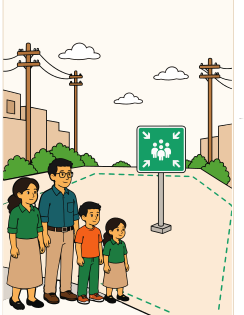
Nearby meeting point
If family members were in the home or its vicinity, head to the safe meeting point agreed upon in advance. This location should be far from facades, walls, posts, cables, and other hazards.
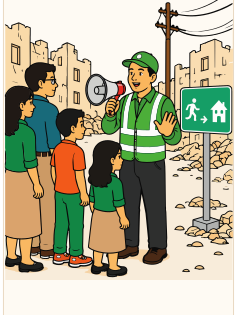
Official evacuations
Do not try to cross affected areas, damaged bridges, restricted zones, or dangerous areas simply to reach the designated meeting point. If the authorities order the evacuation of an area, proceed to the designated evacuation site, shelter, or safe area.
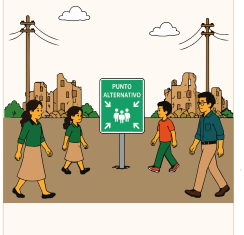
Alternative meeting point
If family members were in different locations, use the alternate meeting point designated in the family plan when it is safe to travel there. Safety takes precedence over immediate reunification.
When it is possible, let your family know where you are and where you are headed. Always follow the instructions of the authorities and stay alert to official information.

3.21How to let others know you are safe
Telephone networks may become congested after an emergency.

Avoid unnecessarily long calls.

When communication services are available, keep messages brief.
A useful message could say:
"I am safe. I am at [place]. I am heading to [destination]. Time: [time]."
If you need help, clearly indicate it:
"I need assistance. I am at [location]. We are [number] people. [Brief description of the problem]."
When possible:

Use text messages or messaging services

Avoid sending pictures, videos and large files

Reduce non-essential communications

Conserve your phone's battery

Keep the family's previously designated contact person informed
A contact located outside the affected area can be useful for centralizing information about different family members when local communications are congested.

Do not rely exclusively on a single app, social network or means of communication.

3.22Conserve your phone's battery
After an earthquake, electricity may remain unavailable for an extended period of time. To conserve battery power:

Reduce screen brightness

Close unnecessary apps

Enable power-saving features

Disable connections you are not using

Avoid playing videos

Avoid long calls

Use power banks when available
Conserve enough power for important communications and for receiving alerts.

Do not turn off features needed to receive alerts or official information when these are available through the device.

3.23People with disabilities and other assistance needs
After the earthquake, the surroundings may have changed considerably.
Debris, broken glass, poor lighting, out-of-service elevators, obstacles, and changes to the usual routes may particularly affect people with disabilities.

Assistance should be adapted to each person's needs.

Do not assume what help they need. Ask when possible.
Promote autonomy and keep the person's essential assistive devices with them.

3.24Initial evaluation of people with disabilities
Before moving:

Check for injuries.

Ask the person how they are doing and what assistance they need.

Check the condition of their mobility or communication devices.

Identify essential medications or equipment.

Assess the route before beginning the evacuation.

Clearly explain any necessary change to the planned procedure.

Do not force unnecessary movements.

Be aware that some injuries may not be immediately apparent.
3.25Accessible evacuation
When evacuation becomes necessary:

Use accessible routes that remain safe.

Follow the established emergency plan.

Do not unnecessarily separate the person from their wheelchair, cane, crutches, walker, hearing aid, communication devices or other essential items.

Request trained personnel when a complex transfer is necessary.

Avoid improvising lifting techniques that could injure the person or those assisting them.

Do not use elevators that have been damaged, are out-of-service, or have not been authorized for use after the earthquake.
If a planned route is no longer accessible, immediately communicate the situation to those responsible for the evacuation or to the emergency services.

Do not leave a person in a hazardous area simply because a conventional evacuation method is not immediately available.

3.26People who use wheelchairs
After the shaking:

Check that the wheelchair is functioning properly.

Visually inspect the wheels, brakes, and essential components.

Remove small obstacles when you can do so safely.

Keep the person in their wheelchair as long as it continues being a safe means of mobility.

Lock the brakes when stationary.

Do not lift or carry a person manually unless necessary.

Do not carry a wheelchair with removable components or components not designed to support the person's weight during a transfer.

If the electric wheelchair stops working, ask the person about the procedure they normally follow to receive assistance.
When a transfer over stairs or significant obstacles is necessary, try to ensure that trained personnel and appropriate equipment are available.

3.27People with visual impairments
After the earthquake, familiar reference points may have disappeared or changed.

If you are providing assistance:
- identify yourself; briefly describe the situation;
- ask how the person would prefer to be guided;
- warn them about steps, broken glass, debris, uneven surfaces and obstacles;
- describe significant changes in the route;
- do not push or pull the person unexpectedly;
- do not separate the person from their cane or other orientation aids;
- if the person uses a guide dog, keep the animal with them whenever possible;
- allow the person to keep as much independence as possible.

3.28People with hearing impairments
Power outages and environmental noise can make communication difficult. Try to:

Establish eye contact.

Use sign language where it is known.

Use clear gestures.

Write messages when necessary.

Use a phone or other devices as visual aids.

Provide written information about evacuations and significant changes.

Provide enough lighting for lip-reading or visual communication.

Do not shine a bright flashlight directly into the person's eyes.
3.29People with intellectual or cognitive disabilities, or neurodivergent people
Sirens, crowds, changes in routine, aftershocks and unknown environments may produce anxiety or overstimulation. Use:

Brief instructions.

Familiar language.

Concrete explanations.

Previously practiced routines.

Visual aids when available.

Personal items that help regulate sensory stimuli when they are part of the person's usual needs.

Avoid yelling, contradictory commands, and unnecessary physical contact.

In shelters or crowded places, try to find a relatively quiet space whenever possible.

Do not use physical restraint as a general method of control.
3.30Medication and medical equipment
People who depend on medication or medical devices require special consideration. Keep the following immediately accessible, whenever possible:

Essential medications

Prescriptions or treatment information

Batteries

Chargers

Mobility aids

Communication devices

Specific supplies

Essential medical information
If a person depends on essential electrically powered equipment and the power supply is interrupted, report the situation as soon as possible to emergency services, the assistance center, or the appropriate provider.

Do not enter an unsafe structure to retrieve medications or equipment without first assessing the risk.

3.31Support system

After an earthquake, activate the support system established during preparedness planning.
Family members, neighbors, caretakers or previously designated individuals can check whether those who need assistance:

Are safe

Were able to evacuate

Have their essential devices

Have their medication

Need medical attention

Need transportation or accessible assistance
Do not enter a hazardous building to carry out this check.

If you are unable to locate a potentially vulnerable person and there is reason to believe that they may be trapped or in danger, report the situation to emergency services.

3.32The days that follow
In the days that follow:

Continue to be prepared for aftershocks.

Respect restricted areas.

Do not enter buildings declared as unsafe.

Follow the guidance on water and food.

Stay informed through official sources.

Conserve available resources.

Keep in contact with family members when communications allows.

Assist vulnerable people in your surroundings.

Keep children away from debris and damaged structures.

Keep pets under control.

Be careful around wires, broken glass, hazardous substances and unstable elements.

Do not interfere with rescue operations.

Report dangerous situations to the authorities.
Returning back to normal may take time.

Do not interpret a decrease in the visible activity of emergency services as an indication that all hazards have disappeared.

3.33Volunteering and community assistance
Community solidarity can be essential after a disaster. However, assistance should be provided in an organized manner.
If you wish to help:

Contact the responsible authorities or the organizations.

Find out about the actual needs.

Follow the coordination instructions.

Do not enter restricted areas on your own initiative.

Do not interfere with search and rescue teams.

Do not handle unstable structures.

Do not distribute unverified information.

Do not obstruct streets or access routes needed by ambulance, firefighters, and emergency response teams.
Spontaneous assistance is most effective when it is safely integrated into the organized response.

3.34Communication and emotional well-being
After an earthquake, people may experience fear, anxiety, confusion, irritability, difficulty sleeping and concern for family members or about possible aftershocks. These reactions can occur in both adults and children.

Try to:

Stay with others.

Stay in communication with family members and trusted people.

Obtain information from reliable sources without continually exposing yourself to disturbing images.

Reestablish basic routines when conditions allow.

Allow children and adults to express their concerns.

Seek professional help when a person experiences an intense or persistent reaction, or one that significantly interferes with their daily functioning.
In children, keep explanations simple and age-appropriate.

Do not promise that there will be no more aftershocks. Explain that further shakings may occur and remind them what to do if the ground starts shaking again.

3.35Emergency numbers
Emergency numbers vary by country and, in some cases, by jurisdiction. Do not assume that a single number works universally throughout the Americas.
Before an emergency occurs, identify and record the official emergency numbers for the place where you live or are staying.

When a real emergency occurs:

First state what happened.

Provide the location as precisely as possible.

Report how many people need assistance.

Briefly describe the existing hazards.

Follow the operator's instructions.

Do not end the call until instructed to do so, unless it becomes unnecessary to do so for safety reasons.
If phone lines are congested, do not make unnecessary calls.

Reserve emergency services for situations that truly require urgent intervention.

3.36Key principles to remember

Danger does not end when the shaking stops
Aftershocks may exist, fires, leaks, structural damages and other hazards.

Observe before moving
Broken glass, debris, wires and damaged structures can turn a familiar route into a dangerous place.

Evacuate when necessary and safe
Do not run nor create crowds.

Do not use elevators until it is safe to do so and their use is authorized
Use available evacuation routes that remain safe.

Stay away from damaged buildings and structures
Aftershocks can cause further falling debris or collapses.

If the ground starts shaking again, protect yourself again
Drop — cover yourself — hold on.

Do not enter unsafe structures to retrieve objects
Life takes precedence over any possessions.

Do not attempt structural rescues unless you are trained to do so
An improper action can result in additional victims.

Help children, older adults, people with disabilities, and those who need assistance
Do so without unnecessarily putting yourself at risk.

Keep pets under control
Do not allow them to escape or roam in hazardous areas.

Use safe water and food
Follow the applicable health and sanitation guidelines.

Use communications responsibly
Brief messages can be more useful when networks are congested.

Get information from official sources
Do not spread rumors or unverified instructions.

Respect evacuation orders and restricted areas
Do not return until it is safe to do so.

If you are in a coastal area at risk of tsunami, evacuate without delay
Move to higher ground or inland areas according to local evacuation routes and guidelines.
Remember
After an earthquake
REMAIN CALM.
Observe your surroundings before moving.
Check if you or the people around you are injured.
Be prepared for aftershocks.
If it shakes again

DROP

COVER

HOLD ON
Evacuate when necessary and safe to do so.
Do not use elevators until it has been determined that they can be used safely.
Stay away from buildings, facades, walls, poles, wires and damaged structures.
Do not enter hazardous buildings.
Do not light a fire if there is a possibility of a gas leak.
Consider any fallen electrical wire to be potentially energized.
Help children, older adults, people with disabilities, and those who need assistance without unnecessarily putting your own safety at risk.
Keep pets under control.
Use water, food, energy and communications responsibly.
Obtain information from official sources.
If you are in a coastal area threatened by a tsunami, evacuate immediately towards a safe area.
And remember the fundamental principle
- Protect yourself first.
- Evaluate the hazards before acting.
- Help without becoming another casualty.
- Stay prepared for aftershocks and follow the authorities' instructions until the emergency has ended.